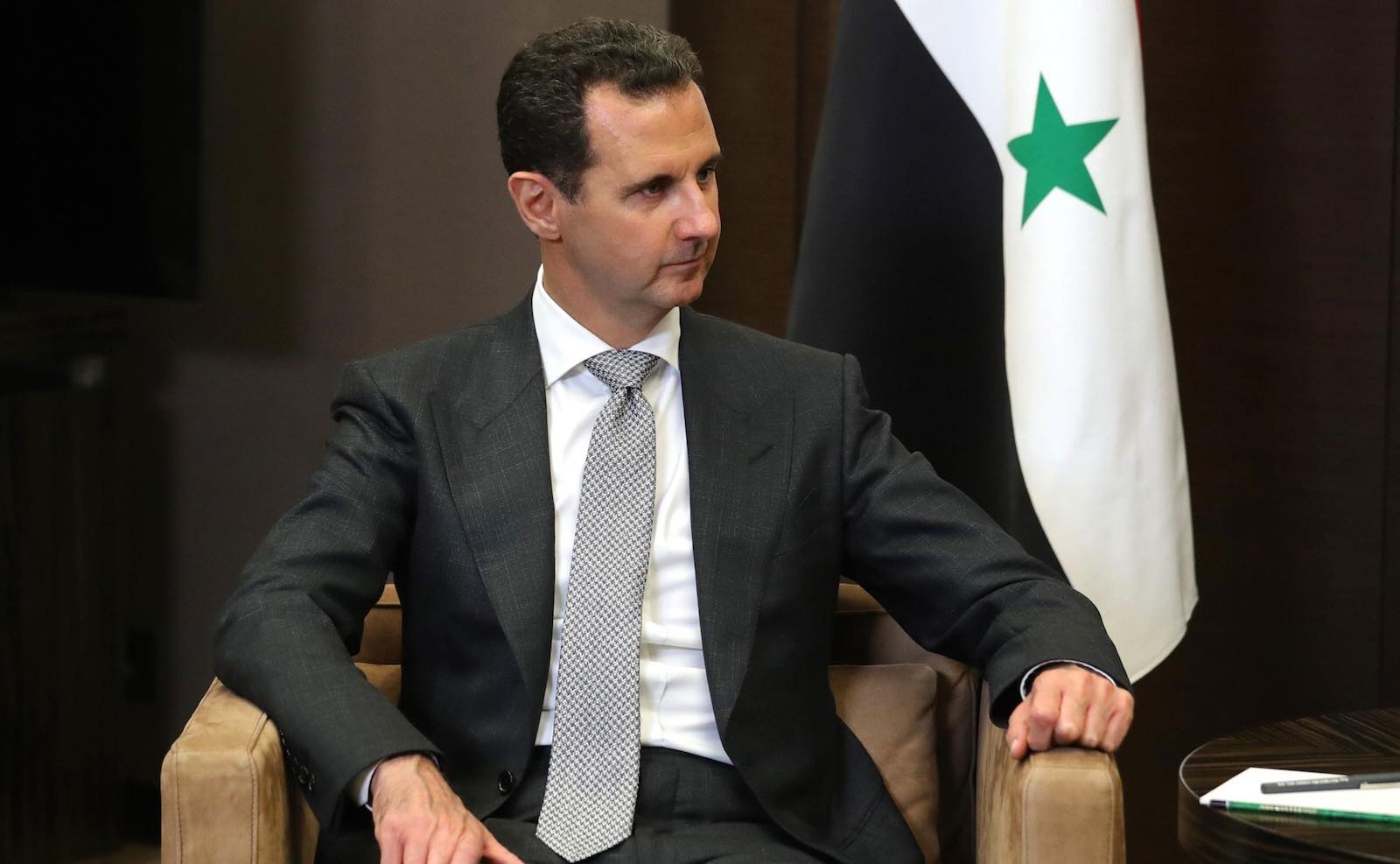
President Bashar al-Assad was the main catalyst for reform in Syria’s economy and to a lesser degree in its political institutions before the 2011 uprising. The Civil War has caused Assad to return to his father’s domestic and regional policies.
By Aiman Mansour* and Joshua Landis
When president Bashar al-Assad assumed power in July 2000, he led Syria on a trajectory of gradual and limited reform. He eased restrictions on the economy. He allowed for greater foreign influence in Syria by encouraging foreign investment, licensing private banks, and pushing tourism. He let considerable light into Syrian society by legalizing satellite dishes, the internet, and relaxing restrictions on the media. To set these reforms in motion, he had to clip the wings of the security bosses, who frowned at his willingness to open the doors of the country. They complained that they would be the ones expected to clean things up once trouble started. They pointed to the Damascus Spring as an early example of how things could go badly wrong. But Bashar al-Assad was convinced that he could win the loyalty of the Syrian public, particularly its youth, if he could modernize along the lines of Turkey or China. To this end, he alternated between two development plans: one was the Five Seas Vision that he elaborated after a visit to Turkey in 2004. It was to turn Syria into the key transport and trading hub of the region. The other was a version of the China Model that was designed to build a “social market” economy that would allow Assad and the Baath Party to retain political control.
Syrian authorities also loosened their grip on society for a number of reasons completely beyond their control. The U.S. invasion of Iraq and its promise to reform the Greater Middle East dealt a major blow to regional stability. By 2004, Washington was demanding that Syria relinquish its traditional control over Lebanon, cease interference its elections, stop supplying arms to Hizbollah, and withdraw troops that had been stationed in the country since the 1976. Damascus viewed this U.S. effort to roll back Syrian regional influence and cut it off from its allies to be made in Israel, as it seemed design to end pressure on Israel to return of the Golan Heights. Even more ominous, it seemed to be a prelude to destabilizing the country and regime-change, if not a full on invasion.
To contain U.S. military intervention in the region to Iraq, Assad opened his country to the hundreds of Salafi-Jihadists who were seeking a way into Iraq to fight the American occupiers. Damascus’ new permissiveness toward Islamists would have the effect of awakening the Islamist currents in Syrian society that had been so violently suppressed in the 1980s. Young Syrians from every walk of life, whether university students or farmers, became mesmerized by the new jihad in Iraq that championed heroic narratives of adventure, revolution, and revenge. Youth were electrified. Students at the University of Damascus, eager to show solidarity with the fighters in Iraq, began to dress in Afghan garb. Washington’s pressure campaign on Syria led to its forced withdrawal from Lebanon on the heels of the Hariri assassination.
A devastating draught that led to the displacement of a million Syrians, combined with the failure of Syria’s state-controlled economy to produce jobs and revenue forced neo-liberal reforms. The down side to these changes was the creation of a yawning income gap and expanding corruption at every level of Syrian society. These changes, whether produced by reform, the expanding U.S. role in the region, or economic weakness and corruption produced social, religious and class discontent that exploded to the surface of society in 2011.
The worst drought on record in the Fertile Crescent killed livestock, drove up food prices, and forced 1.5 million rural residents to the outskirts of Syria’s jam-packed cities
Because of the civil war, Syria’s leaders were left with a single option: to survive. In order to do so, they returned to the policies of Hafiz al-Assad. Syria, haunted by distrust of the international community, plagued by internal divisions, and hemmed in by Western sanctions, has reverted to the inward looking policies it pursued in the nineteen-eighties and nineteen-nineties.
Once the threat of a rebel victory began to recede in 2016, Damascus took steps to tighten its grip on the deteriorating state institutions as well as to restore its regional status.
To tightening control over economic transactions in the country, it limited dollar use in the local market in order to shore up the pound. Police have arrested merchants who continue to trade in foreign currencies and have attacked several leading figures in Syria’s private sector by confiscating their assets. The government seeks to revive key industrial areas, such as Shiekh Najar in Aleppo and Adra in Damascus. These policies are designed to restore vitality to small and medium businesses, which operate in the industrial areas. Despite the need for more foreign investment, the Syrian government will likely hesitate to allow projects led by Turkish or Qatari businessmen for fear that they will enrich and embolden members of the political opposition. During the first decade of this century, the government’s desire to attract Turkish and Gulf investors caused it to turn a blind eye to the growing sympathy of many Syrians outside of the capital felt towards political Islam. During his first ten years in power, Bashar al-Assad permitted the rapid proliferation of mosques throughout the country. Fearing a repeat of this phenomenon, Syrian authorities are likely to insist on investments from secular countries such as Russia and China and from the regional adversaries of political Islam, such as the UAE and Egypt, who prefer maintaining the political status quo and are willing to do business with the Assad government.
The ruling Baath Party, which had been neglected during the first decade of Bashar’s rule, is regaining influence and even dominance in national politics. Despite decisions made to sideline it, such as in the election campaign of 2007, or to encourage greater party freedoms, such as those laid out in the constitutional reforms of 2012, the Baath Party is becoming more visible in both the economy and politics. President Assad is also becoming more involved in running the Party, a role he all but abandoned in his first decade in power.
Hundreds of thousands of Syrians gather for a pro-government rally at the central bank square in Damascus March 29, 2011. REUTERS/Wael Hmedan
Syria’s infamous intelligence
agencies are also being revived. The four main organizations, the GID (General
Intelligence Directorate), PSD (Political Security Directorate), MID (Military
Intelligence Directorate) and (AFI) Air Force Intelligence Directorate languished
during Bashar’s early years. Today, their authority as the central pillar of
stability has been respected. As with the Baath Party, Assad has rediscovered
the importance of his intelligence agencies. Through his National Security Adviser, General
Ali Mamluk, Assad is becoming more involved in the matters of these security organizations.
At the regional level, Syria is gradually regaining influence in Lebanon. Syria has long viewed Lebanon as its backyard. During the civil war, the loss of the mountainous border region separating Lebanon and Syria had a devastating impact on Damascus for guns, money and fighters could be funneled in to the rebels attacking the capital. It sparked a long and difficult battle to regain control of the border region, called the battle of Qalamoun (2013–14). It underscored to Damascus authorities just how key Lebanon is to its national defense.
Lebanon is not only important geographically, but it also serves as a lung for the Syrian economy. The recent banking crisis in Lebanon caused the collapse of the Syrian pound and gutted the savings of many Syrians who traditionally park their money in Lebanon. Lebanon is where Syrian businessmen buy their dollars and squirrel away their profits, while its banks issued the letters of credit and facilitated transactions that Syrian traders depended on.
Since the onset of the Lebanese civil war and the demise of Lebanon’s westward-looking Maronite leadership, Syria became the dominant power in Lebanon. Lebanon’s fragmented leaders, including those of Hizbullah at certain points, have decried the heavy hand of Damascus. All the same, they have remained too mired in their internecine squabbles to slip the bonds of their dependence. It should be remembered that Bashar was sent to Lebanon by his father in the 1990s to become schooled in the dark art of divide-and-rule. Since the international sanctions were imposed and the domestic conflict escalated to a full-fledged civil war, Syria’s focus on Lebanon become almost entirely economic. As Damascus regained its footing with the defeat of insurgents, its rulers are becoming more and more involved in Lebanese politics, supporting the block that eventually won the 2019 elections. Later, Damascus seems to be the main backer of the recently formed technocratic government, which was formed after Hariri’s resignation, most probably to the discomfort of Hizbullah who is interested in maintaining his dominance in his home turf. The economic crisis that Lebanon is undergoing will not diminish Syria’s interest in it. On the contrary, this will only encourage the Syrians to exploit its neighbor’s weakness and deepen divisions to further cement its influence, with the hope that a certain point, the Lebanese economy will start to recover in a way that will positively impact the fragile Syrian economic.
Through its growing influence in Lebanon, Syria is hoping to recalibrate its relationship with Iran which had descended from one of partnership into one of dependence and even vassalage during the civil war. Syria’s restored leverage in Lebanon, acquired largely through diplomatic and political means, is designed to put Damascus back onto an even footing with both Hizballah and Iran. Damascus’s suspicion of Iran has grown most recently as Assad has struggled with Turkey to retake its lost territory in the country’s north, whether in Idlib, north Aleppo, or east of the Euphrates. Tehran’s unwillingness or inability to come to Syria’s aid against Turkey underscored the dangers of relying too heavily on Iran. Putin stepped into the breech to help Damascus face down Turkey, but in the final analysis, Syria will have no substitute for its own military strength if it wishes to roll back Turkey’s military presence.
Syrian forces quit Lebanon after 29 years – China Daily:
As regards Russia, President Assad’s policy toward the Kremlin is the continuation of his father’s. Hafiz al-Assad relied on and enjoyed the strategic-military support of USSR/Russia, that sent military experts to Syria and equipped it with weapon systems. In 1983 the Russians even sent anti-aircraft systems with Russian operators (which were turned over later to the Syrians). Assad allowed the USSR to expand the use of the Tartus naval base and use the T4 air base. Yuri Andropov, the Soviet leader and General Secretary of the Communist Party, said in the1980s that he would not allow anybody to defeat Hafiz. Today, President Putin is providing the same strategic shield to Bashar al-Assad. Bashar al-Assad has offered Russia a 49-year lease of the Tartus naval base and a free hand in its use of the Hmeimim air base. Today, Assad relies more heavily on Russia for the survival of the regime than it does on Iran. Russian air power was decisive in turning back the opposition militias and restoring the Syrian Arab Army’s control over Syrian territory. So too was Russian ground support, which included both regular forces and private contractors, made Damascus more dependent on Moscow than on Tehran.
Despite, Assad’s reliance on Russia, he has been careful not to allow Russia a free hand in reforming the military to become a “highly institutionalized, depoliticized, nonideological, and nonsectarian force.” He has been careful to ensure that the loyalty of its commanders to him and the Assad family remains undiluted.1 Patrimonialism has been the key to the regime’s survival. Nevertheless, both Russia and President Assad share a common interest in restoring more centralized, state-controlled military structures.2 The militification of loyalist forces, that was encouraged by the government during the nadir of Assad’s fortunes to counterbalance the mobilization of antigovernment forces, is today seen as a distinct liability. They challenge state authority; some may be more loyal to Tehran than to Damascus. Assad shares Moscow’s interested in reeling in the multitude of quasi-independent militias, but he has always been careful not to all foreign countries, even Russia, to undo the tight bonds of loyalty between him and his security commanders. If Bashar al-Assad has stayed true to any principle of his father’s regime, it is to the primacy of traditional loyalties. Regime survival depends on it.
In conclusion, Bashar al-Assad’s present policies seem designed to restore a modified version of his father’s Syria. This will not be a full return to a state-controlled economy or the “communism” of the late Hafiz, but it will lead Syria to step back from many of the neo-liberal measures that guided reform before the war. The major lesson that Bashar seems to have taken away from the devastating civil war is that reforms, even those focused primarily on the economy, were too fast and destabilizing. Thus, he is reinvigorating the Baath Party and restoring the security agencies’ control over the daily lives of Syrian citizens. Syria’s regional role, so skillfully built up by his father, was key to national security. To regain some modicum of regional leverage, Bashar is focused on regaining primacy in Lebanon and a more balanced relationship with Hizballah and Iran.
*Aiman Mansour is a Research Fellow at the Jerusalem Institute for Strategy and Security. Until Nov 2019, he served as the Head of the Middle East and Africa Division of Israel’s National Security Council. He was previously Liaison Officer and Assistant to the Special Envoy of the Prime Minister, and Director for Syria and Lebanon, NSC.
PREFACE TO THE ARABIC EDITION OF DESTROYING A NATION: THE CIVIL WAR IN SYRIA
Tadmir Watan: al-Harb al-Ahliyah fi Suriya
(Beirut, Dar Jana Tamer, 2018)
As there has
been such a high demand for an Arabic translation of my book Destroying a
Nation: The Civil War in Syria, which appeared less than a year ago, I am
glad that it now appears for the first time in Arabic in an updated and
extended version.
The fact that
it appears some seven years after the start of revolution and war in Syria provides
an opportunity to look back at developments in Syria with some more knowledge and
insights of what has actually happened. From the very beginning of March 2011,
the Syrian Revolution has been a highly controversial subject because of
completely opposing and conflicting views among the warring parties concerned.
My aim is to look at the developments with some more distance, instead of
choosing sides, and following the motto of Albert Einstein that ‘you can never
solve a problem on the level on which it was created’.
The Syrian Revolution
that started in 2011 did not come out of the blue, but was a result of decades of
developments under Ba’thist rule since 1963. The year of 2011 has become a very
important turning point in Syrian history because the wall of silence and fear
was broken for the first time among large sections of the Syrian population, as
they rose massively against the Syrian regime. And even though Syrian history as
a result might be divided into a period before and after 2011, it would be
better to say that modern Syrian history has been marked by various important
turning points, of which the 2011 revolution is just one, albeit a very important
one which will be described extensively in this book.
There were, of course, more turning points in the period after Syria became independent in 1946, after the French had left the country when their mandatory power ended. I will mention here only three: 1963, 1970, 1976-1982, next to the fourth of 2011.
The first such
turning point was when the Ba’thist military took over power in 1963. The
importance of this turning point lay more in the specific backgrounds of the
military who have dominated Syria ever since, rather than that the rule by the
Ba’th Party itself was all-decisive. This was because the military rulers and
their supporters as from 1963 originated to a great extent from the Syrian
countryside and from the heterodox Islamic minorities that were concentrated in
the Syrian rural areas: Alawis, Druzes and Isma’ilis in particular. Before the
Ba’thist revolution of 1963, the Syrian political scene had been mainly
dominated by urban Sunnis, whereas afterwards the power structure was more or
less turned upside-down, with people from the Arabic-speaking rural minorities
dominating the Sunni Syrian urban majority. This implied a radical social
revolution, which slowed down, however, once these minority people had achieved
higher positions with material interests which they started to defend, just as
the Sunni urban upper class had done in the past.
As far as dictatorship is concerned, it would not be correct to divide Syrian history in a pre-Ba’thist period before 1963, and another period after 1963, because Syria has hardly known anything else but dictatorships or authoritarian rule for as long as it has existed during thousands of years. The Syrian free parliamentarian elections of 1954 were perhaps exceptional, but these provided more a valuable gauge of public opinion at a critical moment, in which they gave an indication of the comparative strength of the rival forces on the Syrian political scene,[1] rather than that there was really a democracy in Syria. In this epoch, which sometimes is described as ‘the democratic years’, the military and intelligence (mukhabarat) were noticeably present behind the scenes just as well.[2]
The military
coup of Alawi General Hafiz al-Asad in 1970 can be considered as a second
turning point, mainly because afterwards Syria was no longer plagued by
military coups and rivalries as before. From that year onwards, it was only one
all-powerful Alawi-dominated military faction that controlled the Syrian scene
for almost half a century, until today.
A third
important turning point caused the issue of sectarianism to be more important
than ever before. In the years of 1976-1982 an extremist offshoot of the Syrian
Muslim Brotherhood, called al-Tala’i’ al-Muqatilah (The Fighting
Vanguards) carried out a whole series of assassinations against Alawis, whether
Ba’thist or not, in an effort to cause a sectarian polarization between the
Alawi minority and the Sunni majority that would destabilize the
Alawi-dominated regime and could finally lead to its downfall. The Islamist radicals, however,
stood no chance against the well-armed and well-organized regime, and their
actions ended in the well-known bloodbath of Hama in 1982, where not only the
Muslim Brotherhood organization was ruthlessly eradicated, but also many people
from Hama who had nothing to do with it. It was an irreversible turning point
in Syrian history as far as the issue of sectarianism was concerned, and the
Hama massacres constituted a ruthless model of suppression which was to be
repeated during the Syrian Revolution that started in 2011, this time not in
one city, but all over the country. The earlier bloody events have had a
profoundly negative effect on Alawi-Sunni relations, which has only increased
after the start of the Syrian Revolution in 2011.
One of the key
questions in this book is whether or not the bloody war in Syria could have
been avoided, and whether it could have been expected. The answer is that it
was unavoidable and could have been expected. What could not have been
predicted, however, were the effects of the so-called Arab Spring and the
foreign interference in the Syrian War that started in 2011.
There has been
some controversy about whether or not one could label the Syrian War as a
‘civil war’. It depends, of course, on the definition one wishes to give to the
concept of civil war. And opinions vary widely on it. According to some academic
literature, however, the Syrian War can be considered as a civil war, although
one should note that it got the clear additional dimension of a war-by-proxy
due to foreign interference and intervention.[3]
Already long before 2011, we have seen how on numerous occasions the
Ba’th regime dealt in a ruthless way with any threats against it, whether these
were imagined or real: people opposing the regime were imprisoned, tortured,
killed, assassinated, or committed ‘suicide with more than one bullet’, or were
dealt with by other repressive means.
A brutal dictatorship with such characteristics and behavior like the
Syrian Ba’thist regime, could not realistically have been expected to give up
power voluntarily as a result of peaceful demonstrations, like those that
started with the Syrian Revolution in 2011. Neither could the regime
realistically have been expected to voluntarily give up its power as a result
of a fierce war-by-proxy on Syrian territory, which was encouraged and
militarily and financially supported by regional proxies, like Turkey, Saudi
Arabia and Qatar, or Western countries like the United States, Great Britain
and France. In my earlier book The Struggle for Power in Syria, I
predicted more than three decades before the start of the Syrian Revolution–
and it was not that difficult to predict – that any effort to effectuate regime
change was (and is) bound to lead to enormous bloodshed. And this is what we
have seen during the years since the start of the Syrian Revolution and are
still witnessing today. Those who did not expect such a huge bloodbath, either
did not know enough about Syrian history, or they were suffering from an
overdose of wishful thinking, or both.
As could have
been expected, the Syrian regime seized all possible means to stay in power. Its strategy of
temporary alliances with the aim of monopolizing power has been repeated on
various occasions ever since 1963 until today, also during the Syrian War that
started in 2011. It did not always matter to the Ba’thist rulers whether they
formed alliances with other parties that were not at all ideologically close to
them, or even with parties that were in fact their enemies, as long as they
could achieve their principal aim, which was staying in power and monopolizing
it. It was the end that justified whatever means.
How could so many foreign politicians have naively expected president
Bashar al-Asad to voluntarily step down as president of Syria, after all kinds
of atrocities the Syrian regime reportedly had committed against the so-called
peaceful demonstrators and, later on, against military opposition groups? They
wanted al-Asad to voluntarily sign his own death warrant, because the legal
president of Syria, in their view, had lost his legitimacy. It was completely
unrealistic, however, in the sense that what they wanted to happen – even
though it might have been justified on basis of their views of justice and
rightfulness – certainly was not going to happen in reality.
The alternative was to militarily defeat the Syrian regime, after which
talks would not be necessary anymore. But direct military intervention was
rejected in the Western democracies involved, just as well.
Nevertheless, by way of an alternative, various Western and Arab
governments chose to militarily intervene indirectly, by arming, financing and
politically supporting the various Syrian opposition groups. This turned out to
be enough to make the regime tremble (tarannah) but not enough to topple
it. And I leave out of consideration here whether an alternative – for instance
a radical Islamist – regime could have been even worse. Whatever the case, it
would have been unrealistic to expect a democracy after the Syrian War.
Most foreign governments claimed that they wanted a political solution,
and this was true in principle. But they only wanted a political solution that
would lead to regime change, and this turned out to be impossible
without sufficient military means. Such military interventions were actually in
violation of international law which bars UN
member states from supporting military action to overthrow other members’
governments.[4]
The results of indirect military intervention have been just as disastrous as
direct military intervention would have been: notably almost half a million
dead, millions of refugees, a country in ruins and a nation destroyed to a
great extent. Foreign military intervention under the United Nations principle
of The Responsibility to Protect, would have required a multi-year huge
military operation, for which not any Western country was prepared.
Reproaching foreign countries for giving insufficient support to help
topple the regime, whereas simultaneously being against any military
intervention appears to be contradictory. Let me therefore clarify what I mean.
I am strongly against military interventions in general because there are so
many examples which illustrate that such interventions mainly lead to disaster.
My point is that the countries that encouraged the military opposition to
confront the Syrian regime, without sufficiently arming them or sufficiently
coordinating their militarily actions, were in practice leading many of the
opposition military into the trap of death.
When in May 2011, the Syrian Revolution was not yet two months old, I
was asked in an interview, whether it would still be acceptable to have direct
contacts with President Bashar al-Asad, because there were already ‘hundreds of
dead’ as a result of the regime’s repressive actions and ‘thousands of people
arrested’. I answered that this would depend on how pragmatic one wanted to be
and concluded that if one did not want to talk to or communicate with President
al-Asad, it was not possible either to positively contribute to any solution.[5]
During television programs on the occasion of the first anniversary of
the Syrian Revolution in March 2012, I argued again that dialogue was key to
any solution. Syrian opposition representatives, however, strongly rejected any
such an idea. I rhetorically argued that if I had the choice – although it was
of course not up to me to make such a choice – I would prefer a 10,000 dead
(which was the number at the time) over a 300,000 dead, which might be the
number if the war would continue without any communication and negotiations
with the regime, looking for a solution.[6]
In fact, the number of dead even turned out to be much higher than 300,000, but
in 2012 this still appeared to be unimaginable to many.
There was, of course, not any guarantee of success with the dialogue I
suggested, but rejection of any dialogue was a guarantee for failure, as we
have seen over the past seven years.
Most of the Syrian opposition at the time were not able to accept any
negotiations with the regime, not only because of their extremely negative and
hostile feelings and emotions towards the regime, but also because they still
expected to receive strong foreign support, as happened in Libya, which caused
the fall and death of Libyan leader al-Qadhafi. The other way around, the
regime abhorred the thought of having to share power with those who tried to
topple them and wanted to bring them before international justice.
Many demonstrators wanted to attract foreign attention via the media in
the hope of triggering foreign help, but the support they wanted did not come
as expected. They also played into the hands of the regime by proclaiming
slogans like ‘the people want the toppling of the regime’ (al-sha’b yurid
isqat al-nizam) or ‘the people want the execution of the president’ (al-sha’b
yurid i’dam al-ra’is). This gave the regime further justification for
crushing the demonstrations and revolt. And slogans like these would not even have
been tolerated in Western democracies.
With some hindsight, and purely theoretically speaking, many Syrians
might not have started the Syrian Revolution, had they been aware of the
disastrous consequences beforehand. But in reality, things do not work that
way.
When asked seven years onwards whether the Syrian Revolution ‘was worth
it’, various opposition authors have argued that ‘if the same history and conditions were
repeated today, most likely people would do the same thing as in 2011’, that
‘it was worth it, at this unique juncture of history more than at any time
before’, and that ‘there was no way of living a different life under a regime
that openly spoke about remaining in power for eternity, as this would have
meant a permanent war against the future.’[7]
Another
revolution might happen again in future, albeit under different circumstances
from those in 2011.
It is as if two worlds existed side by side where the Syrian War was
concerned. In one of these worlds perceived feelings of justice prevailed and
wishes were expressed as to what should rightfully happen. The possibilities –
or impossibilities – of bringing those wishes into reality, however, were not
always really fully taken into consideration or accepted. The coveted aim was
clear, but not the way leading to it.
In the other, second, world, Syria was, and all the time has been, one
of harsh and cruel, if not the most brutal, realities. In this second world the
issue of political and physical survival of the regime and staying in power has
been all-decisive, whatever the costs.
Many Western and Arab politicians still live to some extent in the first
world of what Syria should ideally be; not what Syria really is or has become
as the result of the bloody Syrian War. It is a world of principled
declarations of intentions that are not going to be implemented for lack of
military power or for lack of political will to enforce the principles
contained in those declarations, whether they are issued on a national basis,
by the UN Security Council or other institutions. The declarations and
resolutions issued on the occasion of the battles for Aleppo (2016) and Eastern
Ghouta (2018) are clear examples of this phenomenon.
A well-known Dutch artist who portrayed Syria both before and during the
war made the following comment about the destruction of the historic suqs
of Aleppo during the Syrian War:
‘The rebels entrenched themselves in the Suqs [of Aleppo] as a protection against the heavy artillery of the Syrian Army. So, who, then, is guilty of their destruction?’[8]
It is a delicate question, which also
requires a delicate answer. [And it is, of course, not only about the material destruction,
but much more about the huge human cost in lives, wounded and refugees]. Is the
party that pulls the trigger responsible, or the party that provides the other
party with the motivation to attack it?
Most answers would immediately reveal the supposed sympathies for one of the various warring parties in Syria: either being in favor of the Syrian regime or against it. But there can also be a more neutral answer, which almost by definition will also be considered by the same warring factions as being pro- or against the regime. And that is because many Syrians or foreign observers can hardly abstain from using partisan language. Most of the involved parties expect someone to be either pro- or against the regime, as they would consider it to be shameful if one would not clearly take sides in such a horrendous conflict.
Concerning
the destruction of the Suqs in Aleppo, the people supporting the
opposition would most probably suggest the view that the Syrian regime has been
fully responsible for the destruction in Aleppo, and for that matter of many
other places all over Syria as well. Those supporting the regime, on the other
hand, will argue that it is the opposition that is responsible for all the
death and destruction that has taken place since March 2011. Some of them argue
that had there been no revolt and massive demonstrations, whether peaceful or
not, there would not have been that much killing, destruction and refugee
movements on such an enormous scale.
The armed
opposition groups were not really invited by ‘the people of Aleppo’ to
so-called ‘liberate’ them from the dictatorship of the regime, even though many
may have wanted them to do so, without, however, being able to foresee the
disastrous consequences. The people of Aleppo, and for that matter of any other
Syrian city, are not homogeneous as far as their opinions are concerned.
Therefore, it is not that easy to make such generalizations as ‘the people of
Aleppo by majority want this or that’. There is bound to be a great diversity
of opinion.
Some have
argued that in the conquering of Aleppo by opposition forces, factors such as
rural-urban and poor-rich contrasts have played a role. But many people from
Aleppo are themselves of rural origin, and the majority is not rich, but poor,
albeit perhaps generally less poor than people from the countryside.
Generalizing,
I speculate that it could be said that most people from Aleppo wanted the war
to end, and to restart their normal lives, wherever possible. They did not want
to pay the heavy price that the Syrian War has imposed on them.
When
speaking about the controversial concept of bearing responsibility or
co-responsibility for the disastrous situation in Syria, the harsh reality of
who has won or who has achieved a certain victory or defeat in the war may also
have to be taken into consideration.
It might
perhaps have been perceived differently, had the military and civilian
opposition forces been able to bring peace, and create a ‘new Syria’ with the characteristics
that were described by the Higher Negotiations Council of the Syrian opposition
in Riyadh in 2016 as follows:
‘A political system based on democracy, plurality and citizenship which provides for equality in rights and duties for all Syrians without discrimination on the basis of color, gender, language, ethnicity, opinion, religion, or ideology’.
This ideal,
however, has not at all been achieved. And it is doubtful whether all the opposition
signatories to this Riyadh declaration (2016) would have been prepared to
really implement their stated common principles once they would have taken over
power of the regime. This applied to the Islamist parties in particular. But
that is another point. Here I only want to consider the ideal, albeit
theoretical, situation that these principles would have been implemented.
In such a
case it could have been argued that the opposition war against the regime would
have been justified, and would have been ‘worth it’, because it would have led
to a substantial improvement in the country’s situation. But in reality, it
could not be achieved, because the military opposition – or I should say the
numerous military opposition groups together – were not able to achieve a
military victory over the regime, and create the ‘new Syria’, which they
proclaimed to be aiming for in the mentioned Riyadh Declaration.
As a
result, it can be argued that the opposition groups and their foreign
supporters at least bear a great responsibility, or co-responsibility (together
with the regime) for the disastrous consequences of the Syrian War for all
Syrians, even though statistically, by far most deadly victims and destruction
have been caused by the actions of the regime.
Moreover,
even in case the opposition military would have been able to topple the regime,
the situation could hardly have been expected to have improved, taking the lack
of unity among the numerous opposition groups into account. Even after seven
years of war, no effective unity among the military opposition forces had been
achieved. Various rival opposition groups have been fighting one another as
most wanted power for themselves, not being prepared to share it with others
(just like the regime did not want to share power with others). And I am not
even taking into consideration here the lack of unity and coordination among
the various countries that supported the opposition groups, like the US,
Turkey, Saudi Arabia, Qatar, the UK and France, which all had their own
political and strategic agendas, and their own military client groups and
favorites.
Even after seven
years of bloody war, and some 500,000 dead, many Western and Arab politicians
still tend to be blinded, to some extent at least, by wishful thinking, as a
result of which they officially keep approaching the conflict in Syria from a
supposedly moral high ground.
They have not been
prepared to accept the basic reality, that with a limited will and limited
means only limited goals can be achieved. Various Western and Arab politicians have
thereby indirectly helped the war to continue with all its dead, refugees and
destruction.
The war with the
regime has failed to achieve the opposition’s proclaimed aims of a pluralistic,
secular, democratic and civil new Syrian society, and is apparently going in the
clear direction of being lost by the opposition.
In my view, it would
have been better for foreign countries to back off in the Syrian War and stay
outside of it, rather than to try to impose a solution with insufficient
military means, with the consequences as we know them today.
Isn’t it time to
admit that the war against the Syrian regime is in a stage of being lost? And
if the outcome is already quite clear, what is the use of continuing it, and
shedding even more blood? Or do the countries that have played a role in the
war-by-proxy want the war to be continued with all its dead, refugees and
destruction to the detriment of the Syrian people? Would they like the
opposition to obtain some bargaining chips in future negotiations at a time
when, in practice, there is not much to be negotiated about any longer, taking
the military equation into consideration? Or would they want to stay in Syria
within the context of their regional competition for power?
Upon hearing such
suggestions about ending the war, some will almost certainly be outraged and
say – or shout with the greatest indignation – that it is treason to give up
now, after all the efforts that have been made to help topple the regime.
Others may say that the half-hearted foreign support to the military opposition
could be seen as a kind of treason, to the detriment of the Syrian people. Yet
others may use
the slogan Better Death than Humiliation[9], but they cannot speak on behalf
of all Syrians who have been drawn into this war without their approval, or
against their will, and have become the victims of it. Giving up the struggle might mean
that it has all been for nothing.
Frédéric Pichon has called his book on the Syrian War ‘Une Guerre
Pour Rien’, or ‘A war for nothing’[10].
But in fact, it is much worse than that: the war has not only been for nothing,
because none of the aims of the opposition have been achieved, but it brought
Syria also decennia backward in development and caused irreparable losses and
social damages.
In the beginning of
the conflict that erupted in 2011, it might have been less difficult to reach a
political solution than it was later on. Various countries, including Turkey,
Saudi Arabia, the Arab League and others, indeed made serious efforts to help
finding such a solution. But as from August 2011, various foreign leaders,
including President Obama and other political leaders started to call for
Bashar al-Asad to step aside or step down, and have continued to do so ever
since, albeit more recently with some variations and changes.
French President Macron, for instance, in December 2017, almost seven
years after the start of the Syrian Revolution, once it had become clear that
there was no way that al-Asad was to leave voluntarily, if only because he
turned out to be winning the war, Macron stated:
‘We have to talk to everybody … We have to talk to Bashar al-Assad
and his representatives,’ … ‘Afterwards, al-Asad must answer for his crimes
before his people before international justice.’[11]
While admitting that talks with al-Asad were inevitable, Macron could
have been sure that the Syrian president was rejecting the new French position,
because of Macron’s call for bringing al-Asad before international justice.
It was the same formula, time and again, which constituted a guarantee that
no real negotiations were going to take place. It was a non-starter,
irrespective of its merits of justice.
In a similar change of position, the US administration made it known in
December 2017, that it was now prepared to accept president al-Asad’s rule
until the next scheduled presidential elections in Syria in 2021. At the same
time, however, the Trump administration kept proclaiming that it wanted a
political process that held the prospect of al-Asad’s departure.
If Bashar al-Asad would from his side have declared that he would accept
president Trump to stay on until the next US elections of 2020, it would of
course have sounded ridiculous to many, but similar remarks from president
Trump were taken seriously, even though the US during seven years had not
succeeded in helping topple the al-Asad regime. And depending on the outcome of
the US elections of 2020, it should not be excluded that Bashar al-Asad
survives Donald Trump as president in office.[12]
The position of Qatar, which has been one of the key supporters of the
civilian and military opposition for a long time, changed as well in October
2017, particularly after the other states of the Gulf Cooperation Council
imposed sanctions against it with the accusation that Qatar had been supporting
terrorist organizations in Syria. Former Prime Minister and Minister of Foreign
Affairs, Shaykh Hamad bin Jasim Al Thani, in a reaction, confided that the
support of Qatar for the Syrian opposition had earlier on been fully
coordinated with Saudi Arabia, and that all their common support went via
Turkey, where further arms distributions were coordinated with the United
States, together with Turkey and Saudi Arabia. Shaykh Hamad denied having
provided any support to the Islamic State (Da’ish), and that in case it
would have ended up in the hands of the al-Qa’ida related Jabhat al-Nusra,
which apparently had been the case, this would have been stopped, because that
would, in his words, have been ‘a mistake’. Saudi Arabia and Qatar had focused
on, what he called ‘the liberation of Syria’, but when the two countries
started to quarrel over their common ‘prey’ (by which he meant Bashar al-Asad
and the Syrian regime), the prey escaped. Shaykh Hamad bin Jasim added that it
would be okay if al-Asad would stay on if the Saudis wanted this. After all,
Qatar used to be friends with al-Asad. Shaykh Hamad criticized that there had
not been a consequent policy (siyasa istimrariya) between Qatar and
Saudi Arabia but did not mind to change course if past policies turned out to
have been a mistake.[13]
This change in policy happened after more than 450,000 deadly victims had
fallen and was apparently mainly the result of a dispute between Qatar and
Saudi Arabia, not because of a spontaneous change of views, or special feelings
for the Syrian people.
As far as negotiations were concerned, the Syrian opposition has been
communicating with the Syrian regime for several years through the
successive United Nations Special Envoys
for Syria, but they did so under accompanying statements that made any serious
negotiations impossible, because they demanded as a kind of pre-condition that
President al-Asad and those of his regime with blood on their hands should
leave and should be excluded from playing any role in Syria’s future and should
be court martialed. These demands may seem fully understandable, but they were
unrealistic, because they guaranteed that any compromise or serious
negotiations with the regime were excluded. Moreover, the fate of president
al-Asad is not at all mentioned in the Geneva Communique (2012), which is one
of the main internationally agreed cornerstones of the intra-Syrian
negotiations.
Next to Geneva, intra-Syrian talks took place in Astana, Kazakhstan
(2017- ), and in Sochi, Russia (2018- ). The meetings in Astana resulted in
agreements on a de-escalation of the fighting in specific zones and in
temporary local armistices, but the agreements were violated, and appeared to
be mainly intended as a pause for further war. The meetings in Sochi under
Russian auspices were not successful either. The more the regime was on the
winning side, the less they were willing to really negotiate with opposition
parties with whom they never had the intention to share any real power. Winning
the war would not mean, however, that a political solution would have been
achieved.
On various occasions, Syrian opposition forces were militarily defeated
by the regime, to be subsequently deported to the province of Idlib, not with
any intention to negotiate later on with the defeated military on a political
solution, but rather to defeat them later on in Idlib once the time would be
considered to be appropriate to the regime. In Idlib province the deported
opposition military intermingled with other dominant opposition groups, like
Hay’at Tahir al-Sham, Ahrar al-Sham and other radical Islamist opposition
organizations.
In fact, the regime had always wanted to reconquer the whole of Syria,
and the outcome of this depended to a great extent on the support foreign
parties were willing to supply to their favorite opposition clients.
If, after more than seven years of bloodshed, some Arab and Western
leaders decide to change course and decide that al-Asad should be accepted as
staying in power in Syria and would think it opportune to reestablish relations
and to reopen embassies in Damascus, they should not expect the Syrian regime
to welcome them back. On the contrary, such overtures would most probably be
rejected at first, until political accounts are settled, because the regime
considers foreign interference and support for the armed opposition as one of
the principal reasons why the Syrian War has lasted that long.
Any international reconstruction aid could only be channeled to
government-controlled areas with the approval of the regime. And reconstruction
efforts in areas not under regime control run the risk of coming under fire in
case these areas would be reconquered by the regime. Moreover, it is not
without complications to channel foreign reconstruction aid to areas that are
under the shifting control of a mixture of military opposition groups that
include radical Islamist groups like Hay’at Tahrir al-Sham (linked to
al-Qa’ida), Ahrar al-Sham or the Kurdish People’s Protection Units (YPG).
What might perhaps have been achieved through dialogue with the
regime in the earlier stages of the Syrian Revolution, became more and more
difficult later on with all the killing and destruction that has occurred. The
longer the war lasted, the more difficult it became to negotiate and reach any
compromise. The mutual hate between the conflicting parties is immense.
One might also argue that the regime has never been interested in any
dialogue whatsoever that could have led to drastic political changes or reform
but it has – in my opinion – not been tried long enough. The serious efforts in
the beginning should have been continued. Sometimes one should even make a
serious effort if one is not fully convinced of the possibilities of achieving
success.
What have the countries that supported the opposition received in return
for their insufficient aid and military interference? Four of the most
important issues are: 1) refugees, d) increased terrorism, 3) a strengthened
current of Kurdish nationalism and wish for autonomy, 4) a strong increase of
instability in the Middle East.
Refugees
Considering the millions of Syrian refugees abroad, one would logically
speaking expect that most of them will return to Syria, once the war is over,
but realities may turn out to be quite different. In particular those refugees
who are suspected of having been active against the regime – most of them
Sunnis – may not be allowed to return. A short look at the Facebook pages of
many Syrians will easily show with which side they sympathize, for instance by
using the Syrian flag with three stars, used by the opposition, or the official
flag with two stars used by the regime.
Syria expert Fabrice Balanche has suggested that President al-Asad even
might not want the return of millions of refugees, because Syria was
already relatively overpopulated before the Syrian War, and suffered from
severe economic problems, unemployment, severe draught, water shortages and
other issues that helped trigger the Syrian Revolution. Refusing the reentry of
millions of Syrian refugees might, according to this vision, give the Syrian
regime the opportunity of a new start
with a smaller population which, in the supposed thinking of the regime, might
‘give Syria some air’.[14]
Moreover, it
can be expected that refugees wanting to return to Syria may have to prove that
they were loyal to the regime or at least not against it. All this might imply
rigorous demographic changes to the disadvantage of the Syrian Sunni
population. Fabrice Balanche has convincingly demonstrated that, although
various other factors have played a role as well, the sectarian divide in Syria
cannot be ignored, because it is a key issue, with the opposition areas being
mainly Sunni, and the areas numerically dominated by minorities being
pro-regime.[15]
This divide can have serious implications for the future once the Syrian War
would be over. [On the other hand, it should be noted that many Sunnis from
elsewhere have taken refuge in the coastal provinces of Lattakia and Tartus,
with their Alawi majorities, showing that in this case safety prevailed over
sectarian identity].
Remarkable is also that there has not been any compromise whatsoever
between the Syrian regime and the opposition inside the country. And some
opposition leaders who were originally operating from inside the country, like
Lu’ayy Husayn, leader of Building the Syrian State, have been sentenced to long
term imprisonment in absentia, making it impossible for them to return.
Prominent opposition members abroad who publicly repented their
opposition to the regime and wanted to come back to Syria were refused entry
into their home country, although there have been exceptions.[16]
Terrorism
Terrorism and terrorist attacks in Europe are of course much older than
the Syrian Revolution that started in 2011.
Al-Qa’ida, for instance, had its origins in the Mujahidin in
Afghanistan who, at the time were supported by the United States, Saudi Arabia and
others in their struggle against the Soviet occupation. These Mujahidin
later on turned themselves against their former Western supporters.
The Iraq of President Saddam Hussein used to be a bulwark against the
Iranian Islamic Revolution, which was the main reason for Western countries to
support Iraq in order to contain the expansion or export of the Iranian Islamic
Revolution. The US-British invasion of Iraq in 2003, however, gave rise to a
number of subsequent disastrous developments. In the first place, it led to a destabilizing
war, the end of which after 15 years is by far not in sight. The number of
deadly victims has, according to some estimates, risen far over the million.[17]
Under President Saddam Hussein, al-Qa’ida did not have the slightest chance to
be active inside Iraq. By removing the Iraqi president, however, al-Qa’ida
obtained the chance to become very active inside the country and elsewhere. The
US-British occupation created the fertile soil for the Islamic State to gain a
foothold in Iraq first, so as to later become active from there in Syria and
elsewhere. In fact, the removal of Saddam meant that the United States and
Great Britain laid out a red carpet for Iran to expand its influence in Iraq,
Syria, Lebanon and elsewhere in the Middle East.
Strengthening Kurdish nationalism and the wish for autonomy,
Turkey probably never expected that its ferocious efforts to topple the
Syrian regime in Damascus would lead to a strengthening of the position of the
Kurds in northern Syria, and notably of the YPG, the Kurdish People’s
Protection Units that are at least a likeminded organization, if not the counterpart
of the Turkish Kurdish PKK, which already has fought for decades for Kurdish
autonomy in Turkey, if not more.
As a result of the Syrian War, the YPG emanated strengthened from the
battle, thanks to its well-organized military apparatus that could be
efficiently mobilized by the involved Western alliance in the battle against
the Islamic State in northern Syria. A complicating factor for Turkey was that
the YPG was supported by its NATO ally the United States, also after the
Islamic State had been militarily defeated in the area. One of the motives of
the United States to prolong its military presence in northern Syria could be
to contain Iranian influence in the area, but there is already a strong Iranian
presence elsewhere in Syria, and in order to supply Hizballah in Lebanon a land
bridge is not really necessary like in the past, although it would make it
easier for Iran to extend its influence in both Syria and Lebanon, also
vis-à-vis Israel. It is questionable, however, whether the United States could
easily withdraw from such a delicate situation without difficulties. Logically
speaking, one would expect the United States to give priority to its NATO ally
Turkey over the Kurdish YPG, but it has not done so yet.
Under this situation, the Syrian regime could use the PYD/YPG in an
effort to make their presence in northern Syria as difficult as possible for
Turkey, the United States and other Syrian opposition groups in order to weaken
their positions. It is yet another example of a strategic alliance between the
regime and the PYD/YPG from which both can profit temporarily, as long as it
suits them. Actually, the PYD/YPG could be considered as an enemy of the Syrian
regime, because of its aims of Kurdish political autonomy, but the Syrian War
has temporarily changed the traditional parameters.
It should be noted that the PYD/YPG is a strongly authoritarian party,
which does not tolerate most of the other some fifteen Syrian Kurdish parties. The
United States originally proclaimed that they supported the rise of a more
democratic Syria, but in this case, they prefer to cooperate with an
authoritarian, Marxist oriented Kurdish party, the Turkish Kurdish counterpart
of which is listed as a terrorist organization in both the United States and Europe.
In this case, strategic interests apparently have clear priority.
Whatever the case, Kurdish nationalism and the wish for Kurdish autonomy
have obtained an enormous boost as a result of the war, not only in Syria, but
in the whole region. Efforts to suppress the Kurdish identity are bound to fail,
and may rather encourage Kurdish nationalism even further. Nevertheless, the
Kurds in Syria have a lot to do to put their own political house in order.
Increased instability in the Middle East
As a result of the bloody Arab Spring, the brute suppression of the
revolutions that emanated from it, and the foreign interferences in the
internal affairs of the countries involved, a greater part of the Middle East
has been seriously destabilized and radicalized. Hardly anyone has profited
from it, [Russia and Iran being the exceptions]. Rather, the situation of
almost everyone and every country involved has been seriously damaged and
destabilized.
Had the Western and Arab countries not interfered with their arms
shipments and support against the Syrian regime, there would, of course, also
have been serious efforts of the Syrian opposition to topple the regime,
inspired as they were by the developments in Tunisia, Libya and Egypt. After
all, the leaders of these three countries had been toppled after massive
demonstrations, and, in the case of Libya, after direct military intervention. Without
foreign interference, however, the opposition insurrection would most probably have
been violently suppressed much sooner, as a result of which much fewer deadly
victims would have fallen; there would not have been as many millions of
refugees as there are now, and the country would be less in ruble. Yes, the
Syrian dictatorship would have continued relentlessly just as well, but is also
continued now, albeit it under circumstances that are much worse.
In fact, the war was initiated (in reaction to the atrocities of the
regime) without, however, sufficient means and planning that this war against
the regime could also really be won. Before engaging in the war, interfering
foreign countries should have sufficiently studied the military situation in
order to be sure that their Syrian allies had a realistic chance of winning it;
but they apparently did not. In order to be able to defeat and kill a lion, one
should be sure beforehand to be the stronger and the better armed party, so as to
prevent being defeated and killed oneself.
The development of a war is generally not a linear and predictable
process. Neither can it be predicted with some certainty who will be the party
that takes over power successfully, as has been demonstrated by various earlier
military interventions, like Afghanistan, Iraq, Libya and Yemen.
The defected military of the Syrian Arab Army, who later organized
themselves as the Free Syrian Army and other organizations, did not have the
luxury of comprehensive planning, because their opposition organizations
developed only gradually.
The – direct or indirect – foreign military interventions in Syria have
caused the position of Russia to be strengthened considerably. The main reason
for Russia to intervene was to keep its only remaining regional ally, the Syrian
regime, in power. Without other foreign interventions in Syria trying to
effectuate regime change, Russia would have had no reason to intervene the way
it did since 2015.
What is in it for the regime to have a political solution instead of a
military one? It cannot stay in power forever (even though its slogans maintain
that it will) and therefore it is in its interest to help establish a new Syria
that is inclusive for all Syrians in such a way that a new revolution or
settlement of accounts in the form of revenge is avoided. The regime should
have done so long before the revolution started, or directly afterwards, but
Bashar al-Asad and his supporters choose the path of violent suppression.
It has been suggested that al-Asad hesitated in the beginning of the
Revolution between a more lenient approach and a violent crackdown by
government forces. It was supposedly a ‘fateful decision’ not to have seriously
explored the road of reform and reconciliation in the beginning, certainly when
the disastrous aftermath is being taken into account.[18]
Nevertheless, it is far from certain whether an announcement in the beginning
by the president of reform measures would really have satisfied the
demonstrators as long as the Syrian dictatorship persisted. After all, the
demonstrators were overwhelmed by enthusiasm as a result of the so-called Arab
Spring in Tunisia, Egypt and Libya where the presidents had fallen.
Now it has become much more difficult to effectuate drastic reform
measures. But this in itself is no reason not to seriously try to achieve it. And
it is doubtful whether the regime will make serious efforts in this direction
because this could, in its own perception, imply undermining its own position,
as could have been the case in the beginning of the Syrian Revolution.
Nevertheless, President Bashar al-Asad could begin with drastic economic
reform measures, suppressing corruption and giving political space to others, non-Ba’thists
in particular, to participate in his government, even though it might not be
that easy to find relevant candidates willing to do so after all the bloodshed
that has taken place.
As long as the regime would keep
control over the armed forces and the intelligence services (mukhabarat),
the president’s power would be ensured, and it would be relatively easy to
share half or more of the ministerial posts with others, and to get used to a
type of wider based regime. Various kinds of confidence building measures should
be taken, and relevant UN Security Council resolutions should be implemented,
including the release of prisoners, and so on.
Reconciliation appears
to be an impossibility under the present circumstances because of the prevalent
mutual hate and blaming the other side for the disaster that has happened in
Syria. Nevertheless, serious efforts should be made by the various sides to the
conflict to at least reach a modus vivendi. If no serious efforts are made,
it may take generations to really solve the present conflict, and another
revolution may be in the making.
[1] Patrick Seale, The Struggle for Syria: A
Study of Post-War Arab Politics (1948-1958), London, 1965, p. 164.
[2] Colonel
‘Abd al-Hamid Sarraj, who was Head of Syrian Intelligence (Ra’is
al-Mukhabarat) at the time is a well-known name in this respect.
[3] Nicholas
Sambanis, ‘What Is Civil War? Conceptual and Empirical Complexities of an
Operational Definition’, The Journal of Conflict Resolution, Vol. 48,
No. 6 (Dec., 2004), pp. 814-858. Sambanis studied over 100 conflicts in order
to come to his operational definition of civil war, and the Syrian War that
started in 2011 fits into his criteria.
[4] Jeffrey D. Sachs, ‘Ending America’s
disastrous role in Syria’, Project Syndicate, The World’s Opinion Page,
16 February 2018.
https://www.project-syndicate.org/commentary/ending-disastrous-american-role-in-syria-by-jeffrey-d-sachs-2018-02
[5] ‘Dictatoriaal glamourechtpaar’, Vrij
Nederland, 21 May 2011’. Interview with Harm Botje.
https://www.vn.nl/dictatoriaal-glamourechtpaar/
‘One Year Syrian Revolution, Discussions with
Robert Fisk, Nikolaos van Dam, Haytham al-Malih, Anas Abdah, and others’, with Aljazeera
Arabic, 15 March 2012, presented by Ali al-Dafiri and Ghada Aoways https://www.youtube.com/watch?v=3TYv0IU6ZAo
[7] See: Ibrahim Hamidi, Subhi Hadidi,
Yassin al-Haj Saleh and Ammar Abdulhamid in interviews with Michael Young, ‘On the Seventh Anniversary of
the Syrian Uprising, Was It Worth It?’, Inquiring Minds, Carnegie Middle
East Center, 15 March 2018,
http://carnegie-mec.org/diwan/75773?utm_source=rssemail&utm_medium=email&mkt_tok=eyJpIjoiT0RJd09XVmpOMlJoTjJReCIsInQiOiJJS25HWUpCVGtDV1FXY29OVzdJdk1LUEYrZFwvQ0ptVG9hMkJHZEtUSFQycHBhZEJjMjlcL3ZyUE5jdmRzK0pRT0RaRWorUzJmK29QcGh4VDA5ajdLbU9wb0h6SXdwQ21cL0VnK2R5bFRLTVU0aFJiaCs3MDJjRVN1Q0tXNzJ0VjVBWCJ9
[8] Theo de Feyter, Mensen en ruïnes. Syrië
revisited, 2017, p. 68.
[9] Ali Aljasem, Better Death than Humiliation, Master’s
Thesis, Utrecht University, 3 August 2017.
[10]Frédéric Pichon, Syrie, une guerre pour rien,
Paris, 2017.
See also Nikolaos van Dam, ‘Foreign intervention in Syria: Isn’t it time to
admit that the war against the Syrian regime is being lost?, Syria Comment,
8 March 2018.
[14] Fabrice Balanche, ‘Quel visage pour la
Syrie de demain ?’, L’Orient-Le Jour, 30 December 2017. Balanche
uses the term ‘Une Syrie « aérée »‘.
[15] Fabrice Balanche, Sectarianism in Syria’s Civil War, The Washington Institute for Near East Policy, 2018,
pp. 3-30. http://www.washingtoninstitute.org/uploads/Documents/pubs/SyriaAtlasCOMPLETE.pdf
[16] Prominent among those who repented but were refused re-entry into Syria
was Bassam al-Malik, Zaman al-Wasl, 14 August 2017. Fabrice Balanche, Sectarianism
in Syria’s Civil War, p. 48, notes that Shaykh Nawwaf al-Bashir, a powerful
Sunni tribal leader left Istanbul for Damascus in 2017. By rallying to the
regime, he showed that the Baggara tribe had shifted its support from the
rebels to al-Asad.
[17] According to the calculations of Medea Benjamin and
Nicolas J.S. Davies, 2.4 million
Iraqis may have been killed since 2003 as a result of the US-British invasion,
with ‘a minimum of 1.5 million and a maximum of 3.4 million’. ‘The Staggering Death Toll in Iraq’, Alternet, 15
March 2018. https://www.alternet.org/world/iraq-death-toll-15-years-after-us-invasion; and Sinan Antoon, ‘Fifteen
Years Ago America Destroyed My Country’, The New York Times, 15 March
2018.
[18] David W.
Lesch, ‘Bashar’s Fateful Decision’, in: Raymond Hinnebusch and Omar Imady
(eds), The Syrian Uprising: Domestic Origins and Early Trajectory, New
York, 2018, pp. 128-140. And David W. Lesch, Syria: The Fall of the House of
Assad, London, 2013, pp. 69-86. Ehsani, ‘President al-Assad’s First Speech
– An Insiders’s Account’, Syria Comment, 19 April 2016, notes that ‘Assad’s speech was a classic case of
expectations running ahead of reality. The fact that it was made at all should
have been interpreted that the President did not side with Syria’s hawks.
Ironically, what happened instead was that as soon as the speech was over,
President al-Assad was forever seen as the ultimate hawk himself.’
Robin Wright, an astute journalist and analyst, wrote an article in the New Yorker on “The 1983 Beirut Barracks Bombing and the Current U.S. Retreat from Syria.” She makes the case that the U.S. withdrawal from Lebanon following the horrific 1983 bombing of the U.S. Marine barracks resonates, hauntingly, as U.S. Special Forces pull out of Syria. She asserts that: “Once again, the United States is hastily retreating—abandoning a mission, stranding allies, creating a vacuum for adversaries to quickly fill, enabling Islamic extremists, weakening American credibility globally, and leaving the Middle East, the world’s most volatile corner, even more unstable.”
This argument, grounded in a belief in American exceptionalism as well as its ability to fix or improve bleak situations, makes sense to many. Many Americans believe that that the U.S. should not retreat from the Middle East in the face of failed American military interventions in Iraq and Afghanistan. But this noble attitude does not fully examine the background against which the U.S. retreated from Beirut, Iraq, Damascus and Kabul.
As someone who lived the Lebanese civil war as a
volunteer in the Red Cross and observed closely the preparation and execution
of the invasion and occupation of Iraq I consider that Washington’s retreats as
being born out of both its universal values and naivety that clashed with its
foreign policy missions.
In 1982, Washington led the international community in
creating a Multinational force (along with French and Italian troops) to
supervise and safeguard the PLO’s withdrawal from Beirut following Israel’s
invasion and siege of the capital. The withdrawal began in late August and
ended in early September. On September 14, President-elect Bashir Gemayel,
along with a number of his lieutenants, was assassinated in his East Beirut
Phalange headquarters. I vividly remember the pall of gloom that descended on Lebanon,
especially among Christians, following his assassination. On September 16, the
IDF infiltrated a Phalange-led intelligence unit under Elie Hobeika into the
Palestinian refugee camps of Sabra and Shatila to “ferret out” PLO fighters who
remained in the camps. What followed was a horrific massacre of mostly old
people and children. Although previous massacres did not elicit the world’s
outcry, the magnitude of the Sabra and Shatila massacre was not only met with an
international outcry, but also damaged the reputations of the Phalange and the
IDF.
The Israeli public, in contrast to the Arabs, held the largest demonstration in Israel’s history in Tel Aviv and called for the IDF to withdraw from Lebanon. It was only a matter of time before Israel was pressured to withdraw from Lebanon. The murder of Gemayel and Israel’s gradual withdrawal changed Lebanon’s civil war dynamics. The new president Amin Gemayel, brother of Bashir, did not command the full loyalty of the Christian Lebanese Forces, whose leadership had begun to fragment; Antagonistic forces rushed to fill the vacuum left by Israel’s withdrawal. Led by Walid Jumblat, the Druzes, supported by leftists and pan-Arab forces, defeated the Lebanese forces in the Shouf mountains; and the government of Amin Gemayel tried and failed to control West Beirut, which witnessed a mass mobilization of leftists, Shi’a Islamist groups and the Shi’a Amal party.
In the meantime, President Reagan, moved by the sorrowful
and distressing flurry of unfolding events, decided to change the mission of the
MNF. On October 28, he signed National Security Decision Directive (NSDD) 64,
“calling for the United States to work toward the withdrawal of foreign forces
from Lebanon, help rebuild the Lebanese Army, and contribute to an expanded MNF
if necessary.” But his well-intentioned and ambitious new mission was not
timely reinforced by a bigger and stronger American force just as internecine
fighting and regional meddling in Lebanon reached a new peak.
Even
at an early age I shared my father’s concerns for the U.S. Marines. The
question that troubled me most was why the U.S. Marines located their
headquarters next to the airport in Beirut’s most volatile area. In hindsight,
other horrific events should have underscored the fleeting objectives of
Reagan’s new MNF mission. A new tool of terror, traced to Ayatollah Khomeini’s effort
to reinterpret Imam Hussein’s martyrdom in Karbala in 680, justified suicide
bombings based on fighting oppression and injustice. Before the bombing of the
U.S. Marine barracks in October 1983, the Israeli military headquarters in Tyre
and the American Embassy in Beirut were bombed respectively. Robert Baer, a
shrewd CIA operative, contemplated that the United States failed to notice the
warning signs of the 1983 bombing.
President
Reagan had two choices: be fully involved militarily in a country in the midst
of a brutal civil war or get out. Reagan grasped the danger of the treacherous politics
of Lebanon and chose to get out. Since then, the U.S. should have grasped the
fact that any mission in the Middle East has to be buttressed by significant
American power not only to affect the context in which American troops are
involved but also to dictate the outcome of American involvement. In other
words, half-hearted measures in the Middle East do not work!
So,
indeed, “the ghosts of Lebanon are in Syria today,” as Ryan Crocker observed.
But herein lies the main question: how deep is the U.S. commitment to to its
mission in Syria? The hard truth is the U.S. has neither a well-defined mission
nor one that it is able to implement within a reasonable time span. The U.S. set
itself up for tragedy. It also set the Kurds up for tragedy.
In
this respect, President Trump’s decision to pull out of Syria—like Reagan’s
decision thirty-five years—is about saving American lives!
Posted by Joshua on Thursday, September 19th, 2019
By – BOB BOWKER, who is a former Australian ambassador to Jordan, Egypt and Syria. He is now an Adjunct Professor at the ANU Centre for Arab and Islamic Studies.
19 Sep 2019 – Published first on the Interpreter at the Lowy Institute & reprinted on Syria Comment by permission of the author
Engaging Assad, while repugnant, is better than words of sound and fury delivered that makes little difference.
Bashar al-Assad, like his father before him, proved determined to not ask open-ended questions in Syria about the relationship between state and society (Photo: Kremlin.ru)
Syria is one among several Middle East regimes which believe that repression, if not used in moderation, provides a necessary answer to challenges to the existing political and social order. Accordingly, Western governments have to decide the relationship they wish to have with Syria, and its neighbours and friends, including Iran – and how they wish their values to be reflected in their approaches to that relationship.
Understanding the consequences of the Syrian tragedy for our interests should lead us to support carefully calibrated re-engagement with the Assad regime. The alternatives are worse.
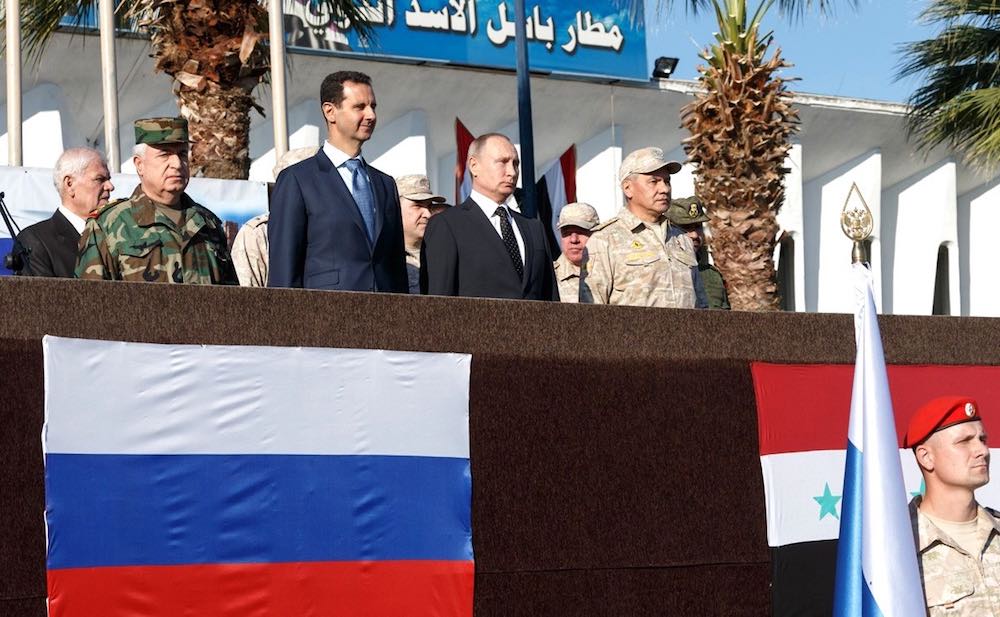
Bashar al-Assad with Russia’s Vladimir Putin at Khmeimim air base in Syria in December 2017 (Photo: Kremlin.ru)
Without respect for principles and institutions of international humanitarian law, and efforts to hold accountable those who breach them, predictable and constructive dealings between states and the harnessing of human potential are hardly possible. An absence of respect for those principles, both domestically and in dealings between states – and the weakening of political will to defend robustly the values of political liberalism and the moral authority of international norms and values – brings us closer to the scourge of war.
But in the case of Syria, behind that self-evident truth are complex political and moral issues.
If concerns exist at all in Damascus for the absence of accountability for brutality in the name of security, or for the opportunities for recruitment and indoctrination afforded by burgeoning prison environments, torture, and other abuses, they are seen as issues of a lower order than the immediate need to preserve the identity and essential character of the state itself.
Advocacy for human rights must be framed within a realistic acceptance that any return to effective political leadership will have to come about within the existing power structure.
Bashar al-Assad, like his father before him, proved determined to avoid the asking of open-ended questions about the appropriate relationship in Syria between state and society. Meanwhile, the ideological disposition of opposition groups was reduced from mid-2011 to an Islamist-inspired rejection of the existing social and political order.
Whether responsibility for the human tragedy of Syria rests mainly with the Syrian regime, other governments, or non-state actors, it is the Syrian poor, and the marginalised, who have been demonised, dehumanised, and exploited. And the values that best protect Australia’s interests at the global level have suffered as respect for international law has been set aside by the parties to the conflict.
The challenge is to find an acceptable balance between upholding core principles of international humanitarian law in the Syrian context, and recognition that without a return to economic growth and security, those principles, however worthy we may consider them to be, will matter little to those Syrians who are most vulnerable.
The application of economic sanctions to Syria – in practice, a manifestly inhumane, ineffective, and altogether despicable assault on the most vulnerable elements of Syrian society – add to the challenges ahead.
There is no chance of security or durable progress in Syria without economic advancement. The opportunity costs, in terms of wasted human potential, corruption, and human rights abuses associated with repression, insecurity, and conflict all weigh heavily against the likelihood of achieving levels of balanced economic performance that can restore infrastructure and human capital and combat Syria’s growing ecological threats and food and water insecurity.
But in Syria, and elsewhere in the region, advocacy for human rights must be framed within a realistic acceptance that any return to effective political leadership will have to come about within the existing power structure. A leadership that has proven willing to see the death and displacement of so many of its own citizens is not going to relinquish or genuinely share political power beyond its immediate base.
The incremental advancement in Syria of empowerment, within the rule of law, at all levels, from the state to the society to the household, is as desirable and yet as remote a prospect as ending abuses of human rights. And remaking Syria – or Yemen or Libya – for the benefit of their citizens may not be possible without remaking the wider Middle East.
History suggests that is something to which the rest of the world is unlikely to make a positive contribution. And words of sound and fury delivered in multilateral forums will make little difference in practice to Syrian behaviour.
But if we wish our values to be respected among future generations of Syrians, and elsewhere in the region and beyond, we should be prepared to stand up for those values by using such political, diplomatic, and intellectual leverage as may be available to us. And we should be prepared to take a long-term view of what is required.
Syria, not unreasonably, sees itself as deserving of international recognition as a country of substance and importance in the Arab and regional context. The ending of its isolation from the international community is important to it.
Calibrated, strategically planned re-engagement, in consultation with Western and Arab partners, offers the most likely path to seeing a Syria emerge which, like Tunisia, chooses to benchmark its achievements as an Arab state against contemporary ideas among a younger generation, in Syria and within the wider Arab world, of what it means to be Arab and “modern”. And it is among those ideas of what modernity looks like that the norms and institutions of international law are most likely to be respected.
The extent and timing of steps to help Syria move in that direction may depend, in practice, on a parallel process of realignment of dealings between Washington and Tehran. There must be some semblance of respect for the dignity and rights of its ordinary citizens if re-engagement with Western countries is to proceed. Russian sensitivities would need to be handled with particular care. But there is a strong case, humanitarian, diplomatic, and otherwise, for further exploration of the limits to the possible.
For their part, Western governments will see their interests served best, not by ongoing insecurity and conflict and the imposition of collective punishment in Syria, but by the re-emergence, over time, of a Syria that is once again confident, economically dynamic, socially progressive, and respected within the region.
Posted by Chris Solomon on Monday, June 10th, 2019
Egypt’s King Faruq
First published in Intelligence and National Security, May 28, 2019
70 years on from the end of the Arab-Israeli War, new documents shed light on the political intrigue that surrounded the motives of the geopolitical powers in the region. Just as Israel wields influence with the Arab Gulf States in the ongoing crisis with Iran, the 1940s saw the European powers play a role in the pivotal conflict that drastically altered the Middle East for decades to come.
In this article, Dr. Meir Zamir, Professor Emeritus of Middle East and Intelligence Studies at the Ben-Gurion University of the Negev, analyzes the case of Egypt’s decision to go to war against the nascent Jewish state and the influence of the British Empire that laid behind the Egyptian government. – CS
ABSTRACT
David Ben-Gurion, the founder of the State of Israel, repeatedly accused Britain of provoking the Arab states to invade Israel the day after its establishment in May 1948. To date, historians have not found proof of his accusations in British archives. However, evidence may be found in French archives, especially in Syrian and secret British documents obtained by the French secret services, originating from agents who had infiltrated the Syrian government in Damascus and the British Legation in Beirut. This article, based on French, Syrian, Israeli and British sources, argues that under the Labour government, Arabist MI6 officers in the Middle East, in collaboration with the British High Command in Cairo, pursued an alternative policy to that of the Foreign Office. They provoked Egypt’s King Faruq to go to war against Israel without the knowledge or approval of either Prime Minister Clement Attlee or Foreign Secretary Ernest Bevin, frequently misinforming and misleading them. This watershed research provides details of the goals and modus operandi of those involved in that clandestine plot.
Posted by Matthew Barber on Thursday, April 4th, 2019
A young Yazidi girl and her little sibling live under a bridge in Dohuk after fleeing Sinjar; photo taken Sept. 2014 by Rawaz Adil Nasser
By Matthew Barber
Yesterday, NPR aired an important and heart-wrenching story from Jane Arraf about Yazidi mothers now freed from IS captivity who are forced to abandon their young jihadist-fathered children. I recommend listening to the entire audio of the segment and not merely reading its transcript.
This story raises a number of important issues that deserve additional discussion.
Due to certain religious positions and social norms, Yazidi mothers are being made to choose between remaining in captivity or returning to their families in Iraq while leaving their new children behind. As the Genocide began in Aug. 2014, Yazidi women who were enslaved were able to begin giving birth as early as April 2015 to children fathered by jihadist captors or civilian Arab “owners” who had purchased them. (“Fathered” is a strange word to use since the men who initiated these pregnancies—many of whom are now dead—generally gave little thought to serving as fathers.) This means that the children whom Yazidi mothers must choose to remain with or abandon are now up to four years old.
This is not a new phenomenon in this Genocide, though it is recently becoming more visible. As early as 2015-2016 when I was working in Iraq, I was aware of cases where contact was being successfully maintained between Yazidi rescuers and certain enslaved girls in Mosul, the location of the girls was known, and rescue plans were in place. However, the girls (in the occasional cases I am referring to—not the majority of viable rescues) were refusing to be rescued because they had already given birth to children and did not want to be separated from them. They knew that it would not be possible to return to Yazidi society and keep their children.
The woman interviewed by Arraf in the NPR piece states: “If I wanted to stay with my son, I would have had to stay with ISIS. I was told they take the children away from their mothers.” Her understanding is correct and her fears justified—many Yazidi mothers have been forced to give up the children they have borne as a result of their enslavement. The numbers of these are more likely around several hundred, however, rather than the thousands proposed by one of the women Arraf interviewed. Additionally, many women have been forced by their families to undergo abortions after being rescued. Rescues began almost as early as the enslavement began, so these abortions have been taking place since the first year of the Genocide. Some women who were pregnant when rescued but too far along in their pregnancy to have safe abortions were made to give up their children after carrying them full term.
Not All Mothers Want the Same Thing
In 2016, the Independent reported on the case of a girl who was made to give up her newborn boy after having been rescued. The article did not provide many details as to what happened to the infant, but it gave the sense that the girl viewed the infant as a member of IS and not as her own child.
This raises another important point: the attitudes and experiences of Yazidi women who have mothered children of jihadists vary. Though more attention is understandably being given to the cases where women do not want to give up their children, it is also the case that some women have not wanted to keep the children that they bore due to rape and enslavement. These women have willingly given the children up when prompted to, have themselves sought out the means by which they could give them up, or have willingly undergone abortions. On the other hand are the women whose experiences parallel those of the woman interviewed by Arraf who was absolutely devastated to abandon her son Ibrahim. Mothers wanting to keep their children have sometimes fought tenaciously to do so, resisting their families and the norms of the Yazidi community; this effort, however, is usually unsuccessful.
The family is typically the agent of coercion in cases where women who prefer to keep their children are forced to give them up. Children left in Syria are cared for by the PYD. Those given up in Iraq wind up in orphanages administered by the central government in Mosul or Baghdad (see this article and this article).
The problems facing children fathered by jihadists in Iraq extend far beyond the Yazidi community and the orphanages mentioned above contain children from Sunni mothers and those of other communities. In addition to the dozen or so journalistic articles that have been published on this issue (see examples here and here), a master’s thesis has also been written on children born of rape in Iraq. However, it is important to understand that many aspects of this problem as faced by the Yazidi community are unique and not shared by other communities. This means that calls for the children to simply be accepted into the Yazidi community overlook the range of complexities that belie any straightforward solution.
Avoidance of the Problem
This is an issue that the Yazidi community has largely avoided discussing or bringing attention to. Some Yazidis worry that giving attention to the children produced through enslavement will distract from the much larger number of Yazidi children who were kidnapped in 2014 and who remain missing today.
In response to this tendency, it should be emphasized that looking at the problem of children fathered by jihadists does not necessitate turning away from the Yazidi children who remain missing. We can also understand why resentment would manifest within the Yazidi community when concern suddenly mounts over the children of jihadists while so many Yazidi children remain un-searched for after years of pleading with the international community and Iraqi government to locate and rescue them and so many other aspects of the genocide recovery process remain neglected, unaddressed, and unresolved. Still, I think that it is important for Yazidi leaders to recognize that all human beings deserve care and compassion, and concern for children produced through sexual enslavement does not imply a reduction of concern for the welfare of the kidnapped Yazidi children who remain missing.
Why Is It Difficult for the Yazidi Community to Accept These Children?
First of all, Yazidi religious tradition contains doctrinal positions holding that only a person whose parents are both Yazidi can be considered a Yazidi. In other words, if someone has a non-Yazidi parent—whether the father or the mother—they are not a Yazidi.
This precept is related to the fact that Yazidism does not admit converts—no one who was not born a Yazidi can become a Yazidi. Therefore it is impossible (as Yazidi doctrine is currently formulated) for a child with a non-Yazidi parent to be made a Yazidi and brought into the fold.
There is historical evidence that this position was not always a feature of Yazidi religion. Sources point to the conversion of non-Yazidis to Yazidism four centuries ago. This would mean that the proscription against in-conversion evolved later in Yazidi history.
Proscriptions against in-conversion are a trait of a number of religious minorities within Muslim-majority societies. Druze, Alawis, Yazidis, and Iran-based Zoroastrians all developed such positions at some point in their respective histories.
These proscriptions probably developed in response to Islamic doctrinal positions. Islam does not allow out-conversion and even mandates the death penalty for someone who leaves Islam. This can create a significant degree of discomfort, insecurity, and distress among Muslim families and communities when one of their members leaves Islam—no one wants to have to kill their family member. In such instances, therefore, animosity can be directed against a religious community receiving the convert. This has remained an issue primarily for Christians who, technically, have never instituted a proscription on receiving converts (though in practice they have sometimes avoided receiving converts in Middle Eastern countries out of fear). Instituting proscriptions against accepting converts was a way for minority communities to publicly demonstrate to the Muslim majority that they posed no threat to their religious interests. It’s tantamount to saying: “Not only will we not proselytize you, we will not even accept anyone who attempts to convert to our tradition.” By averring that they presented no competition to Islam, a vulnerable minority could further its own security.
In the case of the Yazidis, this position evolved into a doctrine involving conceptions of purity of sacred bloodlines that should not be mixed. (This even involves caste and sub-caste groupings within the Yazidi community that are not allowed to intermarry.) This issue has become a problem for Yazidis in the modern era as diaspora communities have grown. Germany contains the largest Yazidi diaspora and some Yazidi men have begun secret families with German women. These men travel back to Iraq to visit the Yazidi community but never bring their wives/children with them. Reform-minded Yazidi intellectuals have proposed some modifications to Yazidi doctrine on this matter, but so far without success.
Beyond the issue of parentage, a Yazidi—male or female—who has sex with a non-Yazidi is—according to Yazidi doctrine—considered no longer Yazidi. This has to do with the fact that culturally, intercourse and marriage are intertwined in legitimizing each other; a Yazidi who has sex with a non-Yazidi is viewed in the same way as if they had married a non-Yazidi, which, of course, results in their departure from Yazidism.
This is an area of the tradition that the Yazidi religious establishment had to confront after the Genocide began. Yazidi religious authorities issued a public statement that all enslaved women would be welcomed home as Yazidis and were not to be condemned for the rape that they were in no way responsible for. (This has not meant the end of all stigma and some women returning from enslavement have been denigrated; this largely depends on the emotional culture that varies at the level of the individual family.) It was the scope and public nature of the enslavement crisis that prompted this response from the religious authorities; this was not an isolated instance of rape that could have been hushed up, swept under the rug, or dealt with by shunning as typically happens.
Though this was an important step of social progress, receiving the children of jihadists into the Yazidi community has been a problem area that has proven too challenging for Yazidi religious authorities to reform. Such a step would: 1) upset the entire formulation of Yazidi identity; 2) dismantle long-established Yazidi religious doctrine; 3) simultaneously result in the opening of the door to in-converts, in turn creating a case for Yazidis who want to marry outside of the community—something the community has not yet been ready to tackle; and 4) potentially create new tensions with the majority Muslim population.
Beyond all of these deeply embedded and practical problems, it would understandably be difficult for children fathered by the same IS jihadists who tried to exterminate the community to grow up within the Yazidi community with acceptance rather than shame, abuse, and insults. However, the fact that this problem poses unique religious and identity challenges for Yazidis makes it even more difficult for them to accommodate these children than would be the case for another community surviving a genocide or a comparable scenario of wartime sexual violence.
Pointing this out is in no way meant to excuse or justify the problem; this is merely the reality as it currently stands, which leads to the impossible choice for the mothers profiled in Jane Arraf’s segment.
Responsibility Does Not Lie Solely With the Yazidis
While holding in mind all of the limitations described above, it is also imperative to recognize that Islamic religious norms and their impact on social custom and the legal system also carry responsibility in this picture. First of all, even if the Yazidi community were willing to raise these children as Yazidis, the doctrinal position of the Muslim majority holds that any person with a Muslim father is automatically a Muslim. It is, therefore, not only the Yazidis who consider these children to be non-Yazidis.
The Iraqi state implements this religious position through a long-established practice of refusing to grant a national ID card displaying affiliation with any non-Muslim religion to a person whose father is a Muslim (or even whose mother converted to Islam during the individual’s childhood). In other words, according to legal practice in Iraq, the Yazidis would likely find it impossible to incorporate these children into the Yazidi community even if their own cultural factors did not present impediments to such an option.
Yazidis speak frequently about women who remain missing even after the liberation of IS-held areas; however, it must be acknowledged that a number of these cases involve women who are choosing the children they have birthed and raised over their own return to Yazidi society.
Some of these mothers—who do not see a viable future within the Yazidi community while keeping their children—will live the rest of their lives as Muslims and will raise their children as Arabs and Muslims.
Remaining in their forced marriages could be considered a “choice,” but it is, of course, due to a lack of alternatives. The choices that people must make after all choice has been stripped from them are indeed unthinkable and we must remember who was responsible for this Genocide. In other words, the dilemmas that the Yazidi community is unprepared to tackle were not brought about by Yazidi actions.
Of course, not all Yazidi women who remain in captivity are doing so by choice and it should be recognized that the end of IS-held territory does not mean the end of Yazidi enslavement. Many women—whether they have given birth to children or not—are kept in situations that still constitute imprisonment, even if they were purchased by ordinary Arab men (i.e. not IS fighters). They can remain trapped in a domestic environment, shielded from knowledge of the outside world, and kept unaware even now that IS rule has been eliminated.
If in the future these women are rescued, those among them who have given birth to children and raised them for several years will also face the same heartbreaking dilemmas being experienced now by those who are reconnecting with the outside world.
A Partial Solution
The result of all of this is the heartbreaking reality that can be heard in the sobs of mothers and children in Arraf’s NPR segment.
But before blaming the Yazidis for callousness, it should be considered how incredibly difficult it is for a traumatized and displaced people—whose access to education and basic resources is now even worse than had already been the case in their highly provincial context—to tackle these reform problems amid their struggle to survive a genocide.
Nevertheless, Yazidi leaders should advocate for women who want to keep their children and facilitate their migration to countries where they can raise their children outside of the Yazidi community.
Western countries can assist in this situation by creating programs to resettle those Yazidi mothers who want to keep their non-Yazidi children, and the Yazidi community should respect the wishes of the women. Whether a woman wants to give up her child for adoption or to keep her child, her decision should be accommodated on an individual basis. The Yazidi Genocide served to rob women of all agency; if their wishes are ignored by their families and community upon their return to so-called “freedom,” the hell of the Genocide merely continues for them. The community must place the welfare of the survivors over its larger concerns regarding its image, norms, and desires to force a return to normalcy.
Amid the impossible choices being faced by these mothers and the lack of clear solutions to the problem, what must be remembered is that many of these children are anything but unwanted.
Posted by Chris Solomon on Saturday, March 16th, 2019
As Syria’s Druze seeks out a balance with the Assad regime, the history of the Lebanese Druze’s Progressive Socialist Party and its leader, Kamal Jumblatt, from the Lebanese Civil War era may yield insights into post-war Syria.
The status of Syria’s Druze
community has drifted in and out of the West’s attention during the long slog
of the conflict. Talal el-Atrache’s recent
article highlighted the precarious situation the Druze in Sweida Province,
resting on the frontier of Da’esh, with the only option safeguarding their
independence and security by way of the Syrian government. The brutal raid
illustrated the fraught nature of civilians in southern Syria. Retaliation came
quickly. Pictures circulated on social media showed a capture Da’esh fighter hanged
from ruins of a Byzantine church over an arch known as “the gallows.” However,
the Syrian Druze have also participated in the Syrian Civil War in organized
fighting forces. Aymenn Jawad Al-Tamimi has highlighted the scope of the Druze Arab
Unity Party and its affiliated militia, Saraya al-Tawheed,
operations in Syria. In addition, Tamimi discussed the role Druze women have
taken on by upon recruitment to pro-regime militias, such as Labawat
al-Jabal.
Still, the position of the Syrian Druze throughout the war has been desperate, with some youth refusing to join the Syrian army. One young man told AFP in November, “The army is your grave.” Commentary and analysis has long pondered what the future holds in store for Syria’s Druze. Will they gain enhanced political influence or potential ostracization and persecution?
The Druze in wartime continues to be overshadowed by the Levant’s larger geopolitical events. For some insights into how the Druze transitioned from a combatant force into a peace time political entity, a look back at the Progressive Socialist Party (PSP) and its militia, the People’s Liberation Army (PLA), during the course of the Lebanese Civil War, yields some insights.
Founding of the Progressive Socialist Party to the 1958 Lebanon Crisis
Kamal Jumblatt was born in December 1917 to a powerful Druze family with Kurdish origins. His parents had a long history of protecting Druze interests in Lebanon. His father Fouad obtained an administrator post during the period of Ottoman rule. When Fouad was assassinated by a member of the rival Druze Arslan family in 1921, Kamal’s mother Nazira took over as the head of the Jumblatt family. Kamal traveled to France and obtained a degree in psychology and civil education at the Sorbonne University before returning to Lebanon in 1939. He took over as the head of the Jumblatt family in 1943, the year of Lebanon’s independence. He founded the Progressive Socialist Party (al-hizb al-taqadummi al-ishtiraki) in May 1949. The party was officially secular and had a Pan-Arab orientation. After Lebanon’s independence from France, Jumblatt formed a short-lived alliance with Camille Chamoun that brought down the corrupt and unpopular government of President Bechara El-Khoury in the Rosewater Revolution of September 1952.
However, with the Suez Crisis in 1956, regional tensions soon reverberated in Lebanon. Strong differences emerged between Jumblatt and Chamoun and the Druze leader turned towards Egyptian leader Gamal Abdul Nasser who had taken power in Cairo following the Free Officer’s coup in July 1952. Jumblatt strongly supported the Pan-Arabist movements in the region. When Syrian President Adib Shishakli arrived in Lebanon seeking a place of refuge after the anti-Shishakli National Front coalition (which included the Baath Party and Syrian Communists) overthrew him in a coup, Jumblatt’s threats forced the former Syrian strongman to leave for safety overseas in Brazil. This was largely in response to Shishakli’s brutal offensive against the Druze in February 1954.
By the late 1950s, the chasm between Lebanese President Camille Chamoun and Jumblatt reached a boiling point. In April 1957 Chamoun himself had voiced the opinion that reconciliation with Jumblatt was still possible.[i] However, a U.S. Embassy Beirut dispatch from August 1957 showed that the Druze leader had little trust or patience for his government. The dispatch relayed news of a meeting between Jumblatt and embassy staff where he denounced the Chamoun government and accused it of “gangsterism” in the Chouf and warned that his followers would take up arms to kick Chamoun’s “corrupt” local officials out of the area.
Jumblatt added that Lebanon’s internal situation was “deteriorating to the point where only a strong and respected leader like General Chehab could restore law and order to the country.” Furthermore, he believed that Lebanon “must put its own house in order” to meet the external threat posed by the Syrian-Soviet accord.[ii] By the end of that same month, Jumblatt, railed against the government’s arrest of his supporters, and told the Lebanese press that Chamoun was risking pushing the Druze into a “second Hermel,” a reference to the Druze uprising against the French colonial forces some 30 years prior. Defense Minister Majid Arslan, for his part, said, “I believe the law ought to be applied equally to everyone without discrimination as it has already been applied to my own brothers and friends.”[iii] The 1958 clashes ended with the U.S. intervention and Jumblatt soon found himself included in the unity government cabinet of former Lebanese Army General Fuad Chehab.
The Lebanese Civil War
Logo of the PSP’s People’s Liberation Army
Prior to the Lebanese Civil War, Jumblatt’s party went a period of renewal and strength. Despite the relative security under the Chehabist era, Lebanon was in the midst of social and political turmoil. From 1965 onward, the Druze-dominated movement had seen its membership increase from working class and the economically disenfranchised segments of Lebanese society, largely Druze and Shia, but also contained some Lebanese Sunni Muslims. It was in this climate that Jumblatt’s PSP had essentially positioned itself as an “agent of change.” In addition, the PSP also saw the Baath Party’s successful power grabs in Iraq and Syria and recognized the anti-imperialist sentiments popular in the region as a harbinger for Lebanon.[iv]
However, it was the alliance with the Palestinians that made the PSP the dominant power broker on the Lebanese left. In 1969, Jumblatt, in his role as Lebanon’s Interior Minister, legalized a group of radical leftist and nationalist political parties to allow them back into Lebanese politics. With the military might of the well-armed and politically assertive PLO fully behind it, Jumblatt’s PSP fastened itself in the conflict as the vanguard of the Lebanese National Movement (LNM). This coalition of largely leftist and revolutionary parties faced off against the Christian and conservative elements of the Lebanese political elite. A series of clashes, massacres and retaliations escalated into open warfare in April 1975. Although often described as a sectarian conflict, the Lebanese Civil War, at least in its early phases, had strong ideological undercurrents that transcended sect and ethnicity.
The PSP’s armed wing was known as the People’s Liberation Army (PLA). Some sources put the total number of armed fighters in the PLA at 3,000. Although the party was staunchly secular, the PLA is typically described as one of the largest and most powerful sectarian armies in the civil war era. The militia is usually described as mainly composed of Druze and Shia recruits, with the latter effort occasionally put the PLA in conflict with the Amal militia of Imam Musa al-Sadr.[v]
After the LNM’s secured a series of victories against the Christian Lebanese Forces, Syria’s late President Hafez al-Assad grew wary of the rising power of the LNM, and feared it would threaten the integrity of the Lebanese state if the PLO was able to secure outright power on the Lebanese battlefield. He felt this would undermine Syria’s own influence in Lebanon and control over the Israeli-Palestinian conflict. In December 1975, Assad notified the Lebanese combatants that he would “strike anyone who broke the peace.”
Patrick Seale wrote that Jumblatt was “a genuine man of the left,” adding, “He had early befriended the Palestinians, proclaimed himself a Nasserist, enjoyed cordial relations with Moscow, and from the late 1960s onward had gathered together a vast constituency of Arab nationalists and radicals of all sorts. And by the spring of 1976, as his allies besieged the strongholds of his old Maronite rivals, he scented victory.”[vi] However, for Assad, this could not stand. In his view, the LMN was positioning Lebanon into a state of partition, which played directly into the geopolitical designs of Israel. After the Syrian military intervention in Lebanon in 1976, Jumblatt traveled to Damascus and endured a tense meeting with Assad. No agreement between the two was reached. Assad asserted that Jumblatt allegedly said he wanted to destroy the entire Lebanese confessional system. However, His son Walid later relayed that his father knew about Assad’s designs to divide the warring Lebanese factions and conquer Lebanon.
In early 1977, he traveled to Paris and met with French President Valéry Giscard d’Estaing. There he received promises of international support for Lebanon. Afterwards, he went to Cairo to hold court with Anwar Sadat, who had fallen out with Assad following the Arab’s defeat in the 1973 October War (Yom Kippur War). The Egyptian leader urged Jumblatt to stay in Cairo and allegedly warned him of an assassination plot.[vii]
October 25, 1975 – The Lebanese National Movement announces the end of the fighting in the first phase of the Lebanese Civil War. Kamal Jumblatt (center) is pictured with the SSNP’s Inaam Raad (left), along with Muhsin Ibrahim from the Communist Action Organization in Lebanon, and Anwar al-Fatayri of the Progressive Socialist Party. On the path of his martyrdom, our banners will remain fluttering. 1984.
Kamal Jumblatt was killed by unknown gunmen on March 16, 1977 while traveling to his home in Mukhtara. Apparently he had sought to establish his own autonomous administrative region in the Chouf. Jumblatt had been targeted for assassination earlier in December 1976 with a car bomb, which he accused the Syrian-backed Saiqa militia of being behind the attempt.[viii] Lebanese Communist Party leader George Hawi claimed in a 2005 interview that it was Assad’s brother, Rifaat al-Assad, who was responsible for the assassination.[ix] Others have suggested it was likely a botched kidnapping attempt. The exact details of Jumblatt’s assassination were never fully investigated by the Lebanese government and to this day, like many other crimes of the civil war era, the murder remains unsolved. However, there was a general consensus that the Syrian Air Force Intelligence was behind the incident.
The Martyrs of the Progressive Socialist Party in the Aley Region, 1983
Following Kamal Jumblatt’s death, Walid took over as the head of the PSP. The party and the civil war’s sectarian dimension became dramatically more distinct during this period. The Washington Post reported the cries of revenge by the Druze women at Jumblatt’s funeral, as well as the celebratory gunfire in the Christian sectors of East Beirut.[x] The impact of his death was felt particularly hard by the Palestinians. The Guardian quoted the late Yasser Arafat in 1977 saying, “It’s a tragedy. For us, Jumblatt was the equivalent of several armies fighting on our side.”[xi] The PSP engaged in brutal fighting with the Lebanese Forces in the so-called Mountain War from 1983-1984. The Lebanese Army joined with the Christian militias in an attempt to gain control over the predominantly Druze Chouf district.[xii] The PSP’s militia remained active in the conflict until the conclusion of the war, participating even in the final battles where the pro-Syrian forces routed General Michel Aoun’s troops holed up in the Baabda Palace during the so-called Liberation War. Aoun then left for his exile in France. Following the Taif Agreement, the PLA largely demobilized and entered the newly formed Lebanese Armed Forces and government security services. However, some elements of the PLA stayed on, participating in armed operations against the Israeli Defense Forces occupying southern Lebanon until the latter pulled out in 2000.
Nizar Hassan of the Lebanese Politics Podcast explained how Kamal Jumblatt’s life still lingers in Lebanese society 42 years after his assassination, “The essence of Kamal Jumblatt’s legacy on the PSP is that he represents the intellectual (and in a way spiritual) icon whose ideas and quality shall not be questioned. He is the figure to which all can pledge allegiance and about which they can express nostalgia. It is the hero that they never had ever since, a hero who is seen as a dreamer and visionary who carried the ideals of secularism, humanism and socialism, and beyond all a good and pure man. This is especially relevant because his son and successor Walid represents the other kind of qualities of the Za’eem; mainly political pragmatism and a focus on protecting the Druze and maximizing their share of social surplus. Another aspect of his legacy is the institutions that he created to ensure the party’s continuity and social dominance, which are arguably as powerful today as they ever were.”
March 16, 1985, Pledge and loyalty. A PSP militia fighter greets a member of Amal as a Syrian soldier looks on. Note the faction insignia on the shoulders.
Post-war politics
The fraught nature of commemorating Lebanon’s war martyrs was highlighted by Robert Fisk during the 40th anniversary of Kamal Jumblatt’s death. He noted that Walid has made every effort to warn against the bloody sectarian reprisals that followed his father’s assassination. Walid told Fisk in 2017, “He was trying to get rid of [Lebanon’s sectarian system] because the Muslims and Druze were not equal partners in the system. My father tried to do this peacefully. The elite of the Christians were with him. But the dream of a non-sectarian Lebanon was killed with him on the same day he died.”[xiii]
In 2005, Walid and the Lebanese Baath Party exchanged accusations over the death of PSP military official Anwar Fatayri, who was killed in 1989, after Walid had tasked him with pursuing reconciliation.[xiv] Ultimately, Jumblatt ended up shunning the Syrians in the post-war period. After the 2005 assassination of Rafik Hariri, the PSP became a part of the anti-Syrian March 14th Alliance.
Nazih Richani, the author of Dilemmas of Democracy and Political Parties in Sectarian Societies: The Case of the Progressive Socialist Party of Lebanon 1949-1996, told Syria Comment Walid’s anti-Syrian positions were rooted in the assassination of his father, along with Rafik Hariri, and added, “Walid’s perception that Pax-Americana was eminent and that a ‘New Middle East’ was about to happen in the wake of the U.S. invasion and occupation of Iraq. However, I think he miscalculated the geopolitical, regional, and global conditions and this drove him to the camp opposing Syria.”
A pledge is a pledge, 1981
Walid’s son Taymour has taken over after the official head of the party. However, it is Walid who still retains control behind the scenes. Taymour has indicated to the press that he has a distain for the feudal brand of Lebanese politics.[xv] Nevertheless, the third generation of Jumblatts look set to continue on at the helm of the PSP. At a memorial commemorating Kamal’s 1977 assassination, Walid told Taymour, “Walk forward with your head held high, and carry the legacy of your grandfather.”[xvi]
Hassan touched on how the PSP had to reorganize in Lebanon’s post-war politics, “Unsurprisingly, the civil war gradually destroyed the ‘political party’ aspect of the PSP and empowered the sectarian militia character…[however,] the last few years have seen a conscious effort to resurrect the PSP as a fully functional political party (similar to what Samir Geagea did with the Lebanese Forces), as opposed to a one-man show. This is however is very unlikely to make any significant change as Taymour, Walid’s son who possesses none of the requirements for leadership, was handed the throne without any democratic process and in contrast with Walid’s insistence in the past that he is against ‘political inheritance’ and would encourage internal elections for new leadership.”
Still the PSP continues to be plagued with the lasting stigma of being a relic of the civil war’s sectarian character. One Syrian Social Nationalist named Elijah said, “Kamal Jumblatt was a man of principles and ideology, who did not sell himself to the highest bidder, as a Syrian Social Nationalist I respect that, even if I disagree with him.” He went on to lament the current state of the PSP, “For a party that is so progressive and socialist, they ended up representing Druze as only a sect, like most of the other Lebanese parties, and they are today a shallow image of what they used to be.”
Richani said, “Since 1977, in spite that the PSP’s ideology remains secular, conflict dynamics in a vertically divided society proved to be a formidable challenge. The secto-political system of representation that was engineered in the 19th century by colonial powers (France, the British, and the Ottomans) vying for influence was further reinforced by the French with the 1943 constitution. This in turn was consolidated with the Taif Accord of 1990. Certainly the objective conditions played a significant role in transforming the PSP into a predominatly sectarian-based group. But agency, like everything in history, played an equally important role.”
The PSP’s “reluctant heir” shares a strong resemblance to his grandfather
Hassan said, “The PSP today is a
sectarian party that maintains social dominance through a variety of mechanisms,
but most important is the clientelist relationship between supporters and the
Jumblatt family. This has two dimensions: the resources offered directly in
return for allegiance (such as jobs, healthcare support or material assistance)
and the influence on the distribution of state’s resources (most importantly
jobs, but also access to healthcare and bringing in state investments into the
Druze areas). I can say that it is not individuals that support Jumblatt, it is
the communities. The communities support Jumblatt and avoid any confrontation
with him because they are worried about not being supported in the future. So
the basis of support is largely material. On the other hand, there are the
social-psychological aspects, such as the inherited sense of love and
affiliation, the habitual involvement in PSP affiliated civil society
organizations from young age, and the legacy of the civil war. The latter is
also a major pillar of Jumblatt’s legitimacy: there is a perception that Walid
Jumblatt offers protection for the Druze. He represents a well-connected,
pragmatic, but also courageous figure that would pull strings to avoid harm,
and if needed lead the violence when harm is inevitable.”
The flag of the Lebanese Democratic Party, the PSP’s primary rival within the Lebanese Druze community.
Following the Lebanese parliamentary elections in May 2018, the PSP engaged in violent clashes with its longtime Druze rival, the Lebanese Democratic Party (LDP). An office belonging to the PSP was bombed with an RPG, killed a local PSP volunteer and community activist named Alaa Abi Faraj. LDP head Talal Arslan was accused of harboring fugitive. The issue was later buried between the two sides.[xvii] However, the tension still exists between the PSP and LDP and most recently were manifested in a spat involving Sheikh Nasreddine Al Gharib, a pro-Damascus Lebanese Druze figure who did not approve the journey of Sheikh Naim Hassan, the head of the Druze Spiritual Council, who is aligned with Jumblatt. Subsequently, Sheikh Hassan was barred from entering Syria. Wuel Abu Faour, a leader in the PSP, weighed in on the controversy, saying the move by the Syrian government was “further evidence of the return of the regime to its previous practices of intervention in internal Lebanese affairs.” The LDP defended Damascus. Its spokesperson Jad Haidar responded that Syrian sheikhs were required to obtain special identification for travel to Lebanon.[xviii]
Hassan said, “The LDP is incomparable to the PSP in size, power or ideological significance. It has no clear ideological tendency, no hero figure to give its current leadership legitimacy, and no major influence on the state’s resources. In the last election, the number of votes that the LDP leader Talal Arslan received was embarrassing to say the least; and if not for his inflation by the Free Patriotic Movement (an anti-Jumblatt strategy), he would have been largely insignificant on the national political scale. There is also quite a lot of hatred towards Arslan among the pro-Jumblatt communities for his support of the FPM’s major entrance into the politics of majority Druze areas in the last election, as he is seen to contribute to a political strategy that aims to weaken Jumblatt politically and revive sectarian tensions between the Christians and Druze of Mount Lebanon.” The PSP currently has two cabinet positions in Lebanon’s newly formed government. Ayman Choucair, the State Minister for Human Rights Affairs, and has been in parliament since 1992. Choucair previously held other cabinet posts, including Ministry of Human Rights Affairs, Environment, and Agriculture. He was also the PSP’s director for the party’s office in Damascus from 1985 to 1991. During his time as the Minister of Human Rights Affairs, Choucair used his platform to pressure the Lebanese security forces over their treatment of the Syrian refugees in Lebanon. Following the deaths of four Syrian refugees in July 2017, he said, “To preserve the army’s image and prevent any rumors that may be malicious, we ask the relevant leadership and judiciary to open a transparent investigation into…the causes that led to the deaths.”[xix]
Another PSP member, Wuel Abu Faour is the Industry Minister.[xx] He was previously the Minister of Health and was first elected to parliament in 2005. Faour lauded Russia’s role in securing the release of the Syrian Druze women who were taken captive by Da’esh in November 2018. He noted that Taymour played a role in working with the Russians on the situation. He said, “These recent events showed that Taymour Jumblatt’s confidence in the Russians was in place especially after the liberation operation. Further discussions about future arrangements related to the Druze’s situation in Syria are under way. A suggestion proposed that the Druze wanted for military service would join the fifth legion led directly by Russia, which is receiving positive feedback among Druze.”[xxi]
This relationship between Russia and the PSP comes amid Moscow’s resurgence in the region and in Lebanon. Faour suggested that the ties between Russia and the PSP were both long running and enduring. He explained, “The relation between [the PSP] led by Walid Jumblatt and the Russian Federation is historic. Russians preserve their relations with their historic allies and remember the great role of Kamal Jumblatt, who was awarded with the Order of Lenin among very few figures in the world. They also cherish the common friendship and struggle they share with Walid Jumblatt and want to consolidate the relation with his son Taymour.”[xxii]
Hassan shared his thoughts on Taymour’s future leadership of the PSP, “Taymour is far from a competent leader in any person’s mind, including the staunchest supporters of the Jumblatts. But the idea is that he is young and still learning, so we should give him a chance; this was the justification to support him in the 2018 election. It is hard to predict whether the PSP will continue to dominate Druze politics in the future. On one hand, Taymour is a very pragmatic person when it is no longer civil war times and people need visionary change-makers. He does not represent any ideological standing, he does not have a particularly left wing or progressive rhetoric, and we have not seen any impressive leadership moments yet. But on the other, the PSP’s mechanisms of social control and dominance remain very strong, which makes it difficult to imagine how its influence could be declining anytime soon. The major variable to watch in the near future will be the rise of independent political movements in the Druze-majority areas (such as the group LiHaqqi), which is already influencing the PSP and pushing it in a left-progressive direction. This will either end in the PSP adopting the causes of these movements and preventing any potential loss of support to them, or the beginning of the end of feudal politics. The next decade will help us know what to expect.”
The PSP will proceed into the coming decades in an environment with a heightened sense of community awareness, political activism, and growing desire for reform, equality, and better governance among Lebanon’s younger generation. The legacy of Kamal Jumblatt, frozen in time in 1977, will shape and guide the party. Although the past is present, whether or not the PSP can respond to the future remains to be seen.
[i]
U.S. Department of State, Embassy Beirut Telegram, April 11, 1957
[ii]
U.S. Department of State, Embassy Beirut Telegram, August 27, 1957
[iii]
U.S. Department of State, Embassy Beirut Telegram, August 28, 1957
[iv]
Nazih Richani, Dilemmas of Democracy and
Political Parties in Sectarian Societies: The Case of the Progressive Socialist
Party of Lebanon 1949-1996, (St. Martin’s Press, New York, 1998), p. 80-81
[v]
Edgar O’Ballance, Civil War in Lebaon,
1975-1992, p. 16
[vi]
Patrick Seale, Asad, The Struggle for the
Middle East, p. 280-281
[vii]
Saad Kiwan, Jumblatt’s legacy still
echoes in today’s Lebanon, The New Arab, March 22, 2015, https://www.alaraby.co.uk/english/comment/2015/3/22/jumblatts-legacy-still-echoes-in-todays-lebanon
[viii]
Edgar O’Bllance, Civil War in Lebanon,
1975-1992, p. 62
[ix] “George
Hawi knew who killed Kamal Jumblatt,” Ya Libnan. June 22, 2005
[x] Stuart
Auerbach, “Jumblatt Buried As His Followers Avenge Murder,” The Washington Post, March 18, 1977, https://www.washingtonpost.com/archive/politics/1977/03/18/jumblatt-buried-as-his-followers-avenge-murder/f858f618-bf32-4e25-b492-9d7043c4925b/?utm_term=.a5e308277118
[xi] “From
the archive, 17 March 1977: Lebanese leftist leader Kamal Jumblatt assassinated,”
The Guardian, March 17, 1977, https://www.theguardian.com/world/2015/mar/17/lebanon-kamal-jumblatt-assassination-archive-1977
[xii] Nora
Boustany, “Druze-Christian Fighting Spreads,” The Washington Post, December 13, 1984, https://www.washingtonpost.com/archive/politics/1984/12/13/druze-christian-fighting-spreads/5a88f929-51e0-4f81-ba4b-bd07176b8e57/?utm_term=.28811272bcff
[xiii]
Robert Fisk, “On the 40th anniversary of Kamal Jumblatt’s death, is trouble
brewing again in Lebanon?,” The
Independent, March 19, 2017, https://www.independent.co.uk/voices/lebanon-civil-war-walid-jumblatt-christianity-anniversary-a7638021.html
[xiv] Maher
Zeineddine, “Jumblatt: Accusations of Fatayri murder aimed at hindering
national reconciliation,” The Daily Star,
February 14, 2005, http://www.dailystar.com.lb/News/Lebanon-News/2005/Feb-14/2588-jumblatt-accusations-of-fatayri-murder-aimed-at-hindering-national-reconciliation.ashx
[xv] “Five
new faces to follow in Lebanon’s parliament,” Agence France-Presse,
[xvi] “Lebanon’s
Jumblatt affirms son Taymour as political heir,” Middle East Eye, March 19, 2017,
https://www.middleeasteye.net/news/lebanons-jumblatt-affirms-son-taymour-political-heir
[xvii]
“1 killed in post-election clash in Lebanon town,” Xinhua News Agency, May 8, 2018, http://www.xinhuanet.com/english/2018-05/09/c_137164860.htm
[xviii]
Sunniva Rose, “Syrian decision causes controversy among Lebanese Druze,” The National, March 4, 2019, https://www.thenational.ae/world/mena/syrian-decision-causes-controversy-among-lebanese-druze-1.833101
[xix]
“Lebanon’s human rights minister calls for probe into Syrian deaths in custody,”
Reuters, July 6, 2017, https://www.reuters.com/article/us-lebanon-refugees-syria-minister-idUSKBN19R1FC
[xx] “Lebanon’s
new Cabinet lineup,” The Daily Star, February
1, 2019
[xxi]
“Lebanese MP: Sweida hostages were freed by Russia,” Arab News, November 12,
2018, http://www.arabnews.com/node/1403716/middle-east
Nationalism, War, and The Future of The Middle East By S. Farah for Syria Comment – January 25, 2019
“Nationalism is a great danger for Europe, for all the
European countries. In the history of Europe, nationalism has always meant
wars, and the last great war started right in the heart of Europe… The real
breakthrough, made at the end of World War II is leaving behind nationalism and
national egotisms.”
This is how Professor Valerio Onida, the former president of Italy’s
constitutional court expressed his concern about rising nationalism in Europe
in a televised interview. While nationalism as a cause of war in European
history has been well established, it has been overlooked when politicians and
pundits discuss the Middle East.
What is Nationalism
Nationalism is the political movement that rose in Europe in
the 18th century that led to the emergence of the nation-state. Before
nationalism people did not give their loyalty to the nation-state but to other,
different forms of political organization: the city-state, the feudal fief and
its lord, the dynastic empire, or the religious group.
Broadly speaking, two types of nationalism emerged from
Europe – propositional nationalism in Western Europe and ethnic nationalism in
Eastern Europe. Propositional nationalism, also referred to as civic
nationalism, is an inclusive form of nationalism based on individual rights and
the values of freedom, liberty and equality. The oldest form of propositional nationalism
is French nationalism, which is rooted in the French republican ideals of
liberty, equality and fraternity. The French model of citizenship is linked to
belonging to universal republican institutions, not to a specific identity or
religion. When granting full citizenship to Jews during the French Revolution,
the Count of Clermont Tonnerre told the National Assembly, “We should grant
everything to Jews as individuals and nothing as a nation.” Classifying
people by their ethnicity is illegal in France; no direct census questions can
be asked that would determine the exact ethnic, racial or religious makeup of the
society. The nation of “liberty, equality, fraternity” treats all
people equally with no differentiation.
The other form of nationalism that emerged in Eastern Europe is ethnic nationalism; it mines race and history to create politics that sacrifice individual liberty to the will of the majority. An example of this type of nationalism is German nationalism, which claims that the true essence of a nation emerges from history, culture, and ultimately, race.
The Olympic Torch-bearer runs through the stadium at the 1936 Berlin Games
While forced resettlement and mass killing has happened throughout human history, the emergence of the ethnic nation-state and the attempt to create ethnically homogenous geographic areas in Europe in the 20th century led to ethnic cleansing and genocide—most notably the Holocaust—but additionally, the expulsion of Germans from Polish and Czechoslovak territory, the ethnic cleansing of Bosnian Muslims in Bosnia and Herzegovina, the Serbs in Croatia, and the Albanians, and later, Serbians in Kosovo.
Prisoners of the German Buchenwald concentration camp Anonymous | AP
Embedded in each national movement is a national myth: it
might over-dramatize true incidents, omit important historical details, or add
details for which there is no evidence. These legends and constructed
narratives create imagined communities that give rise to a sense of delusional,
inflated self-worth—what Professor Valerio Onida referred to in the opening
quote of this article as “national egotism.” The English Nationalists argued
that England was the kingdom that, of all the kingdoms in the world, was the
most like the kingdom of Jesus Christ. And the French believed that France had
a special mission as representative of the most advanced form of western
culture. And almost always in every national myth there are stories of victimhood,
aggrievement, and a sense of superiority. These national myths, along with
irredentism, led Europe into endless wars, culminating in WWII.
Nationalism Arrives in the Middle East
For two thousand years, the Middle East had been ruled by
empires: the Roman, the Byzantine, and the successive Islamic empires, all culminating
in 400 years of Ottoman rule. A multitude of cultures lived side by side, while
people and ideas traveled freely across these vast polyglot empires. By the
19th century, European ideas of nationalism began to spread across the Middle
East.
The First Genocide
Turkish ethnic nationalism came from central and eastern Europe through various channels. Émigré and refugees from Hungry and Poland (as well as Tartar exiles) brought this chauvinistic and illiberal nationalism into the seat of the Ottoman empire. The Armenians and Assyrians were its first victims. The Young Turks, a nationalist movement, in an effort to ‘Turkify’ the new republic, executed a systematic campaign to exterminate the Assyrians and Armenians from eastern Turkey, a plateau they had inhabited for 3,000 years. As many as 1.5 million people were killed in what is today known as the Armenian Genocide.
Armenians say up to 1.5 million of their forebears were killed in a 1915-16 genocide by Turkey’s former Ottoman Empire; Turkey has the figure at 500,000 (AFP/Getty) ( AFP/Getty )
Turkey has since been locked into never-ending wars with Kurdish nationalists who themselves aspire to create their own ethno-nationalist state on part of the Turkish state.
Arab Nationalism Usurps Syrian Patriotism and leads Syria Into Multiple Wars and Economic Sanctions
Arab nationalism drew inspiration from 19th-century
Western ideas. In 1911, intellectuals from throughout the Levant formed an Arab
nationalist club in Paris where the first Arab congress took place. Later,
Damascus became the coordinating center of the Arab nationalist movement. While
the idea did spread to other places like Beirut, Cairo, and Baghdad, nowhere
did Arab nationalism inspire so much passion as it did in Syria, which Nasser
of Egypt would later refer to as “the beating heart of Arab nationalism.” As
Arab nationalists took control of the Syrian government, they preoccupied
themselves with the greater Arab cause. In schools across all of Syria,
children stood every morning and saluted the Arab nation, and the green map of
the vast Arab nation replaced the Syrian map in every classroom. Arab
nationalists in Syria were aggrieved and felt betrayed by the West for dividing
their nation with the Sykes-Picot Agreement. But the greatest affront to Arab
nationalists was the creation of the state of Israel that they viewed as
another Western betrayal. Syrians took the mantle of destroying Israel and
resisting the Western plots in the region. This overarching goal led Syria into
multiple wars and economic sanctions, which they wore as a badge of honor.
Arab nationalism asserts that the Arab nation is the group
of people who speak Arabic, inhabit the “Arab World,” and who aspire to belong
to the same nation. Arabs, Phoenicians, Copts, Assyrians, Berbers, Jews, and
all those who live in the designated Arab world and speak Arabic are the people
of this great nation. But this diverse group of people and cultures, from the
depths of Arabia to the far reaches of North Africa, dress differently, eat different
cuisine, and do not share the same history. The purist Arab nationalists insist,
however, that language is the strongest foundation for a nation, arguing that the
varied languages spoken in the Arabic peninsula, the Levant, and in north Africa,
are dialects of the same language. But the looser definition of a dialect
states that a dialect should be understood by speakers of other dialects of the
same language without formal training, a test that would be difficult to pass for
someone in the Levant listening to a person from Morocco. Many successful
countries are multilingual, like Switzerland and Singapore, each with four
official languages. And despite the fact that all the contiguous countries of Central
and South America—with the exception of Brazil—speak the same language, and
even share a similar history and religion, none of these countries aspire to be
one nation.
While Egyptians flirted with Arab nationalism during the
Nasser era, they had a deep sense of self as a separate entity, and their
loyalty was to Egypt first. The Egyptian flirtation with Arab nationalism came
to an end with the Camp David accord. Syrians, indoctrinated with Arab
nationalism, viewed the actions of the Egyptian leadership as treasonous and
short-sighted. This view of other Arab leaders as stooges of their Western masters
was a common theme amongst Arab nationalists in Syria. These nationalists
thought that they were the representatives of the pulse and aspiration of the
Arab street. This delusion, however, came crashing down during the past eight
years of war in Syria: that Arab street was pulseless while Syrians were being
killed and their cities destroyed as a part of a brutal
regime change operation to punish Syria for its decades of opposing
the West’s grand plans and defending the honor of their imagined nation.
The Rapture
Another brand of nationalism, Jewish nationalism or Zionism,
began in Eastern Europe; it aimed to establish a homeland for the Jewish people,
with its sights set on historic Palestine. As of 1920, a British report showed
that there were just over seventy thousand Jewish persons living in British
Mandated Palestine, many of whom had arrived in the preceding 30 years. Jewish
emigration and colonization of historic Palestine continued primarily by
unassimilated Eastern European Jews. In 1948, as Israel declared its
independence, Egypt, Jordan and Syria attacked Israel, and in the 10 months of
fighting that followed, Israel occupied 60% of Palestinian areas—including West
Jerusalem—far beyond the Jewish state allowance proposed by the 1948 Partition
Plan.
This conflict triggered significant demographic change
throughout the Middle East. Around 700,000 Palestinians fled or were expelled from
their homes in the areas that became Israel and have never been allowed to
return. Over the next several decades, Israel occupied more land from its
neighbors and continued the colonization of Palestinian land. And almost all
the Jewish communities that have colored and enriched much of the Middle East
for centuries in cities like Aleppo, Damascus, Baghdad and Cairo vanished, with
many emigrating to Israel or the U.S.
The refugee camps which sprung up in 1948 became permanent residences in exile
Israel’s Declaration of Independence speaks of equal rights
for all its citizens; Israeli human rights groups have, however, documented
several laws that discriminate against its Palestinian population, which
largely still live separately from its Jewish population. Recently, Israel’s
legislators passed the Nation
State law that says that only Jewish Israelis have the right of
self-determination in Israel, ignoring the rights of its Palestinian citizens.
The Knesset also voted down
the Basic Law Equality bill which proposed that “The State of Israel shall
maintain equal political rights amongst all its citizens, without any
difference between religions, race and sex”. While many of Israel’s founding
fathers were secular, the messianic dimensions of a Jewish state on biblical
land was inescapable. Today, the strongest support for Israel in the West comes
from Evangelical
Christians who believe that for the rapture to occur, the Jews must
return to the promised land.
The Way Forward
After WWII, Europeans realized the ills of nationalism and moved to create a new political structure for the continent. They deemphasized borders between their states, allowing for the free movement of people, workers, goods and services, and created supra-national institutions that service the entire European community. The global financial collapse of 2008, however, exposed serious flaws in the structures of the Euro and other weaknesses in the new post- nationalist European project. The Middle East also has to find its way past nationalism to create stability and bring peace to the region. If not in a union similar to the one being attempted in Europe, then perhaps the answer lies in what Nassim Nicholas Taleb, author of The Black Swan and Anti Fragile calls ‘fractal localism.’
The Rapture is but one of many biblical prophecies. Ammiel
Alcalay, a poet, in After Jews
and Arabs, Remaking Levantine Culture, examines the long and rich relationship
between Arabs and Jews, and between the three monotheistic religions in the Levant
that predated nationalism. He ends his work by quoting Shmuel Trigano:
When Isaiah announced “In that day
shall Israel be a third with Egypt and with Syria, a blessing in the midst of
the land…Blessed be Egypt my people, and Syria the work of my hands, and Israel
my inheritance” he was certainly not predicating a union or a fusion into a
state, an empire, but the opening into a space for three people passing beyond
a stage of belligerency, of the state, the leaping beyond formal boundaries.
Mr. Alcalay continues:
Somewhere between visions based on
the old prophecies and the need for a new covenant, between closed doors and
full streets, the magic of old places and the locked rooms without song, a
space remains, a space for a poetics and a politics of the possible.
The plight of the Druze hostages:Why Washington should change its approach in Syria By Talal el-Atrache – @TalalElAtrache For Syria Comment – 8 Nov 2018
Throughout the Syrian war, the Southern Province of Sweida, in coordination with the Syrian army, had succeeded in protecting itself against the jihadist attacks on the province’s Western border with Deraa, and on the Eastern flank, adjacent to the Syrian Desert.
By the end of summer 2018, as the war seemed to reach an end in Southern Syria, the local paramilitary units were partially demobilized. The Syrian army units stationed in Sweida’s Desert were redeployed to the southwest of Deraa, where they joined the fight against an Isis enclave nestled at the foot of the Israeli controlled Golan Heights.
The demobilization was a fatal mistake. On July 25, at dawn, hundreds of Isis fighters emerged from the Eastern Desert. They carried out a coordinated attack marked by suicide bombings, shootings, and stabbings targeted mainly at the Eastern villages overlooking the Syrian Desert. The poorly armed local villagers, men and women, from 12 besieged villages fought bravely against the invaders, but six villages succumbed to the fundamentalist group as it carried out door-to-door massacres with the help of some local Bedouins.
The attack had two objectives. The first was to force the Syrian army to halt its offensive against the Isis enclave in Deraa. The second was for ISIS to provoking a massive exodus from the Druze Mountains.
Within less than two hours, hundreds of Druze fighters rushed to the targeted areas, killing more than 80 ISIS members. Dozens of Druze fighters from Mount Hermon and from the Damascene suburbs of Jaramana and Ashrafiet Sahnaya arrived that same day and joined the combat. The besieged areas, including the six ambushed villages, were liberated by the end of day, boosting the morale of the local population. More than 250 civilians and local Druze fighters lost their lives and another 250 people were injured, in what has become the bloodiest day for the province since the beginning of the war.
Over the next few days, the army dispatched hundreds of soldiers and armored units, before launching a major counterattack in the Eastern Desert. By September,ISIS had lost more than 3000 square kilometers of land, and became completely encircled in al-Safa hills, a 250 square kilometer volcano in the middle of the desert east of Sweida.
ISIS lost the Sweida battle but managed to capture 31 Druze hostages: 20 women and 11 children.
The local fighters found and rescued a woman who had managed to escape in the desert, while a second woman, shot in the head by the fundamentalist group, died.
For the next three months, the hostage issue became the major political, social and humanitarian concern in the Province of Sweida. ISIS conditioned the release of the abductees to the withdrawal of the Syrian army from the Eastern Desert, the neutrality of the Druze, the release ofISIS fighters and their relatives, and the payment of ransom. Damascus and the Druze delegation in charge of the hostage issue systematically rejected ISIS’ conditions, as they would have put the Druze Mountains in harm’s way and strengthened the fundamentalist group. As a result, ISIS killed two of 29 Druze hostages. Muhannad Abou Ammar, a 19 year old university student, was beheaded on August 1.
An older lady, Tharwat Abou Ammar, was shot on October 1. Another 65 year old captive died in custody. The video of the beheading and the pictures of Tharwat’s body covered in blood, published online by ISIS, angered the local population. They were aimed at putting pressure on the government.
On October 19, six Druze hostages were liberated in exchange for the release of 17 women (ISIS relatives/wives) held by the Syrian government, as well as a dozen Bedouin captives that had been kidnapped by some local Druze fighters in the aftermath of the July 25 attacks.
This was the first part of a negotiated agreement between Damascus and ISIS that also included a ceasefire in the Eastern Desert of Sweida, where the Syrian army has been fighting ISIS for the last three months with the help of Russian air force. According to some estimates, between 800 and 1000 ISIS fighters are now surrounded in the Safa volcanic field in the desert.
However, the truce collapsed on November 3 in addition to the second part of the deal that stipulated the liberation of seven Druze women and three children in exchange for the release of 35 ISIS relatives. The group demanded the release of 35 fighters from government custody, but was met with rejection since the initial deal only included civilians.
ISIS has had recent military success in Hajin near the Euphrates city of Deir ez-Zor, where it has killed some 327, US-backed fighters belonging to the Kurdish-led Syrian Democratic Forces since the beginning of the military operation there in September. ISIS has regained self-confidence and launched several assaults from the Safa Volcano, before being quickly rebuffed. On November 5, the Syrian army started deploying considerable reinforcements around the volcano, which consists of a plateau of black rocky hills where ISIS has not only been able to successfully resist for more than a month, but even launch deadly attacks against Syrian troops, killing more than 400 Syrian soldiers in the last three months. The Fourth Army Division (one of the toughest) and the Fifth Corps (advised by Russian officers) have deployed alongside Hezbollah units and the Palestine Liberation Army for the upcoming battle against ISIS. The impressive military buildup intimidated ISIS and forced the group to renegotiate.
On November 8, Syrian State media said that the government troops have freed all remaining Druze hostages kidnapped by ISIS. The army’s operation occurred in a remote area Northeast of Palmyra. However, some analysts believe that the liberation of the women and children was part of a prisoner’s deal exchange.
Meanwhile, the Syrian army launched a new assault against Isis on Thursday in the Safa hills. According to a member of the Druze delegation in charge of the hostage issue, there have been a few disagreements between the Americans and the Russians who were assisting the Syrians in the negotiations with ISIS. The Russians wanted to transfer all ISIS fighters from the Safa Volcano to the north of the Province of Hama, a region currently controlled by Hay’at Tahrir al-Sham (ex-Nusra, affiliated to al-Qaeda), while the Americans wanted to gather them in the Hajin region.
The refusal of Washington to cooperate with the Syrians and the Russians in the battle against ISIS has left a hole through which ISIS has been able to operate. The Americans have forbidden the Syrian army from penetrating within a 55 km radius buffer zone surrounding their military base in al-Tanf, 120 km east of the Safa Volcano. This base sits on the strategic Damascus-Baghdad highway. Damascus has declared this buffer zone problematic as it is preventing the Syrian army from cleaning up the area. The government believes the buffer zone is being used by Isis to move its troops undercover between Northern and Southern Syria, and between Syria and Iraq.
In Northern Syria, the US-backed Syrian Democratic Forces (SDF) have halted their military campaign against Isis after suffering heavy losses in the Hajin area in the Euphrates and following clashes against Turkish forces in Northern Syria. The Kurds, who lead the SDF, are focused on their struggle against the Turkish army after President Erdogan announced his intention to eradicate the SDF.
This leaves ISIS with enough room for maneuver to regain influence either in the Euphrates or along the Syrian-Iraqi border. The United States’ refusal to cooperate with the Russian and the Syrian armies might be counterproductive with the absence of troops on the ground capable of eradicating Isis.
Damascus also accuses Washington of training Isis fighters converted to moderate rebels, such as the Pentagon-backed Jaysh Maghawir al Thawra. The Syrian government is asking Washington to either contribute to its anti-Isis campaign in the Syrian Desert, or leave the area and let the Syrian army clean up the desert all the way to the Iraqi border.
On October 29, Syria’s foreign minister Walid al-Moallem declared that “under the pretext of supporting Syrian Kurds, the U.S. has established bases in the North of Syria and a base in al-Tanf in the South, which are in reality used to reorganize ISIS terrorists to fight the Syrian Arab Army (…). What for? Because they want to prolong the Syrian crisis in Israel’s interests”.
US officials have declared that al-Tanf base serves as a launching pad for counter ISIS operations, even though the US coalition has never been involved in any effort to eradicate ISIS to the south of the Euphrates Valley, such as when ISIS invaded Palmyra, the suburbs of Damascus, and the Province of Sweida.
Washington maintains its base in Tanf as leverage in any future negotiations with the Russians. Its strategic goal is to stop Iran from establishing an East-West land corridor stretching from Tehran to Beirut that serves as an arms supply route to Hezbollah.
After the Syrian army and the Iraqi Popular Mobilization Units cleaned ISIS out of most of the desert, the US base in al-Tanf is becoming obsolete as an anti-ISIS tool. Sooner or later, Washington’s choice of maintaining Tanf will risk helping ISIS, rather than hurting it.
Saudi Arabia, Shi’ism and the Illusion of Reform
by Robert G. Rabil – @robertgrabil
October 30, 2019
The emergence of the Kingdom of Saudi Arabia is inextricably associated with the Wahhabi school of Islam. The Saudi-Wahhabi pact goes back to the eighteenth century when Sheikh Muhammad ibn ‘Abd al-Wahhab (1703-1792), the founder of the Wahhabi-Salafi school of Islam traveled to Diriya, the stronghold of the Saudi tribe, and struck a deal with its chief. The pact served the interest of both parties by expanding their respective political and religious influence throughout the regions of Najd and Hijaz.
Basing his ideas on the writings of classical Salafi scholar Ibn Taymiyyah , al-Wahhab rejected shirk (idolatry, polytheism) and bid‘ah (heretical religious innovation), which he believed permeated the holy land of Islam. He believed in the return to the authentic ways of the salaf al-salih (pious ancestors) and advocatedtawhid (oneness/unity of God) and transcendence of God. He called for unity and the purification of Islam. His puritanical movement became known as the Muwahhidun. Significantly, he justified leveling the charge of takfir (unbelief) on those he considered engaged in shirk. For example, the failure of Muslims to observe all the pillars of Islam was tantamount to committing kufr (unbelief). His definition of tawhid centered on Muslims’s exclusive worship toward God alone. In other words, it was Kufr to associate any other being or thing in the Worship of God. This constituted for him the divide between Islam and kufr, and between tawhid and shirk.
In this respect, the Shi’a, and their offshoot sects such as Alawis, Ismailis, and Zaydis, were considered as the worse of mushrikoun (polytheists) for they have associated worshipping God with venerating the infallible descendants of Prophet Muhammad. More so, Shi’a traditions, among other Islamic and non-Islamic traditions, such as tawassul (supplication), Shafa’a (intercession of prophets and Imams), tabarrruk (seeking of blessings) and ziyara (visiting the tombs of venerated religious figures) only deepened the Wahhabi identification of Shi’ism with polytheism and idolatry. The corollary of this identification made warfare against Shi’ism a Wahhabi religious duty.
Between the years 1794-1802 the Saudi-Wahhabi movement destroyed many holy shrines in today’s Iraq, including the Prophet Grandson Imam Hussein’s shrine in Karbala in 1802. Imam Hussein’s martyrdom in 680 at the hands of Umayyad Caliph Yazid at Karbala was most formative for Shi’a ideology and tradition. This martyrdom became central to Shi’a identity, tradition, and theology because it epitomized Imam Hussein’s opposition to tyranny, oppression, and the struggle against the chronic injustices of the world.
During the campaign (1902-1932) of Saudi chief Abd al-Aziz to conquer Najd and Hijaz thousands were killed and maimed, including many Shi’a. In 1927, Wahhabi scholars issued a fatwa (religious edict) calling for the expulsion of Shi’a from al-Ahsa in the Eastern province of Saudi Arabia unless they consented to the destruction of their mosques and their conversion to Wahhabism. This anti-Shi’a religious strand became the official view of the monarchy when King Abd al-Aziz proclaimed the establishment of his kingdom in 1932 and made Wahhabism its official religious establishment.
Correspondingly, the Shi’a, as a minority in the kingdom comprising around fifteen per cent of the population and residing mostly in the oil-rich Eastern Province, have been religiously and institutionally discriminated against. Their religious customs, including Ashoura commemoration of the martyrdom of Imam Hussein, were forbidden, the publication and distribution of their religious texts were outlawed, their call to prayer banned, and their centers of religious studies closed. No less significant, they were vilified in textbooks.
The early expression of their grievances was manifested in their heavy participation in the 1950s in the labor riots of the oil fields managed by the Arabian American Oil Company (Aramco). The riots were brutally suppressed by the Saudi National Guard. Subsequently, apparently inspired by the success of the Iranian revolution in 1979, Shi’a demonstrated in the Eastern province. The government violently suppressed the demonstrations, arrested Shi’a leaders and forced a number of Shi’a activists into exile. It was at this time that a cleric Sheikh Hassan al-Saffar, supported by the followers of religious scholar Mohammad al-Shirazi, established the opposition group the Organization of the Islamic Revolution (Munazzamat al-Thawra al-Islamiyya).
Saudi harsh treatment of their Shi’a community began to change in the 1990s, following the invasion of Kuwait by Iraq and the deployment of American troops to the Kingdom. This change apparently stemmed no less from American deeper involvement in the Middle East than from the failure of both Saudi policy of oppression and Shi’a policy of protestation. Sheikh al-Saffar changed the name of his organization to al-Haraka al-Islahiya (Reform Movement), and in 1993 a leader of the Shiite opposition in exile, Tawfiq al-Sayf, led a large delegation of Shia to meet with King Fahd. Meaningfully, King Fahd conceded to some Shi’a demands including permitting them to practice previously banned religious rites, some Shi’a to return from exile, and to guarantee the safety of those returned. Significantly, the King ordered the revision of a school text book that had referred to the Shi’a as a heterodox sect. The new edition added the Twelver Shiite School of Islam to the four Sunni schools of Islam.
This slow and circumspect yet important transformation in the relationship between the monarchy and its Shi’a community gained momentum following the American liberation of the Shi’a from the yoke of Saddam Hussein’s oppression in 2003. Many Shi’a activists signed a statement, titled “Partners in the Homeland,” and submitted to Crown Prince Abdullah. The statement emphasized the loyalty of the Shiites to the Kingdom and called for their integration into Saudi society by removing institutional and social discrimination against them. Moreover, when the Crown Prince became King in 2005, many Shiite leaders and clerics went to the capital to pledge their allegiance to him. Many Shi’a believed that the new King would turn a new page in his relationship with the Shi’a community at large.
It’s noteworthy, however, that a minority of Shi’a, including the militant group Hizbollah al-Hijaz, opposed Shi’a engagement with Saudi authorities. The kingdom has designated Hizbollah al-Hijaz as a terrorist organization and blamed it for several terror acts, including the 1996 Khobar Towers bombing. Conversely, many Wahhabi religious scholars maintained their disparaging views of the Shi’a and opposed any rapprochement with them. Even Saudi religious reformer Sheikh Safar al-Hawali disparaged the Shi’a and called the Shi’a Islamist party Hezbollah of Lebanon the party of the devil.
King Abdullah had to walk a fine line between improving the conditions of the Shi’a, opposing what he saw as Iranian encroachment across the Middle East, and curbing the power of his religious establishment that stood as a hurdle to his reforms. He focused on bolstering the Kingdom’s defenses, enhancing scientific research, fighting al-Qaeda, and curbing the power of the Wahhabi religious establishment as a precondition to enunciate significant reforms. He removed a popular Wahhabi cleric, Sheikh Saad Bin Nasser al-Shathri, from the country’s High Council of Religious Scholars because he criticized the king’s decision to allow male and female researchers to work together in the newly established mixed gender King Abdullah University of Science and Technology. Similarly, he sacked the head of the Commission for the Promotion of Virtue and Prevention of Vice, whose puritanical agents try to enforce the behavioral application of Islamic law. Significantly, he tried to break the monopoly of the power of Wahhabi clerics within the Council of Senior Scholars, who issue official religious rulings, by including in the 21-member Council representatives of all four schools of Sunni Islam (Shafi’I, Hanbali, Maliki and Hanafi schools of jurisprudence). Though he did not include in the Council any Shi’a cleric, he increased Shi’a representation in the Consultative Assembly of Saudi Arabia.
Shi’a cleric Sheikh Nimr Nimr.
Unfortunately, King Abdullah’s reforms not only came to a screeching halt but regressed following the eruption of Arab Revolutions across the Arab world. Protests erupted in the Eastern province few days after widespread protests started in Bahrain on February 14, 2011. The province is only a 30-minute drive across the causeway from Bahrain. In a show of force, the Saudi interior minister Prince Muhammad bin Nayef vowed to crush the protests with an “Iron Fist.” In the following days and months, Saudi authorities clamped down on the protests, killing a number of them, and arresting dozens of them including the preeminent Shi’a cleric Sheikh Nimr Nimr.
In the meantime, feeling threatened by the swift spread of Arab revolutions, the monarchy felt the need to be further legitimized by the religious establishment. On March 6, 2011 the Council of Senior Scholars issued a fatwa acclaiming the rule of Saudi royals and banning demonstrations. Excerpts of the fatwa read:
The Council praises Allah Almighty for what He has bestowed upon the Kingdom of Saudi Arabia with unity of words and action on the basis of the book of Allah and tradition of the messenger, under the wise leadership of legitimate allegiance… Since the Kingdom of Saudi Arabia is based on the Qur’an, Sunnah, the pledge of allegiance, and the necessity of unity and loyalty, then reform should not be by demonstrations and other means and methods that give rise to unrest and divide the community…The Council affirms prohibition of the demonstrations in this country…It is what practiced by the Prophet (peace be upon him) and followed by his companions and their followers.
Since then, in order to maintain absolute power, the monarchy has renewed its firm commitment to its Faustian pact with the Wahhabi religious establishment. This resolve for maintaining absolute power has taken a critical dimension with the ascension to power in 2015 of King Salman and his son crown prince Muhammad bin Salman, who essentially managed to wield effective power in the kingdom. On January 2, 2016, Sheikh Nimr, along with 47 Saudis, was executed for being convicted of terrorism offences. Sheikh Nimr was a vocal critic of the monarchy. But he was not a terrorist.
This is the background against which Prince Muhammad launched his so-called campaign of reforms, which have been no more than a window dressing to his attempt at modernizing and controlling the Kingdom. Fundamentally, Muhammad’s reforms have not introduced any systemic change to the Kingdom’s austere social structure and laws. Under the pretext of fighting corruption, he detained dozens of princes and wealthy Saudis so that he could clip their wings and take a hefty portion of their fortune. He arrested the women activists who campaigned for allowing women to drive. He kidnapped Lebanon’s Prime Minister for not being tough enough on Hezbollah. He has waged a brutal war in Yemen initially foregrounded in Wahhabi proselytizing among Zaydi Shi’a. He arrested dissenting scholars. And most recently, he most likely ordered the gruesome dismembering of the journalist Jamal Kashoggi for being critical of his policies.
Clearly, Prince Muhammad does not tolerate any form of dissent. His absolute power rests on his ability to both check the power of his family members and to maintain the loyalty of the religious establishment. Washington cannot influence the Kingdom’s religious establishment, but it can prod the royal family to remove Prince Muhammad from power in the interest of the welfare and reputation of the Kingdom. In 1964, the royal family forced King Saud to abdicate in response to his blunders. At the same time, the Trump administration should use the inexcusable murder of Kashoggi to persuade the Kingdom to renew the path of slow but steady systemic reform that began under late King Abdullah. As such, Washington can better maintain its strategic relationship with Riyadh. Otherwise, the Trump administration, besides forsaking its moral compass, will definitely make United States complicit in Prince Muhammad’s present and future misfortunes and catastrophes involving Sunni-Shi’a sectarianism and a possible war with Iran instigated as much by Wahhabi theological views of Shi’ism as by geopolitical considerations.
*The views expressed in this article are personal and do not reflect those of Florida Atlantic University.
*The views expressed in this article are also not the views of Syria Comment, which has consistently argued against US-backed regime-change. It is worth reading Yezid Sayigh’s “The Warior King,” in which it is argued that Mohammed bin Salman will weather the Khashoggi murder, his tightening grip over Saudi security explains why.